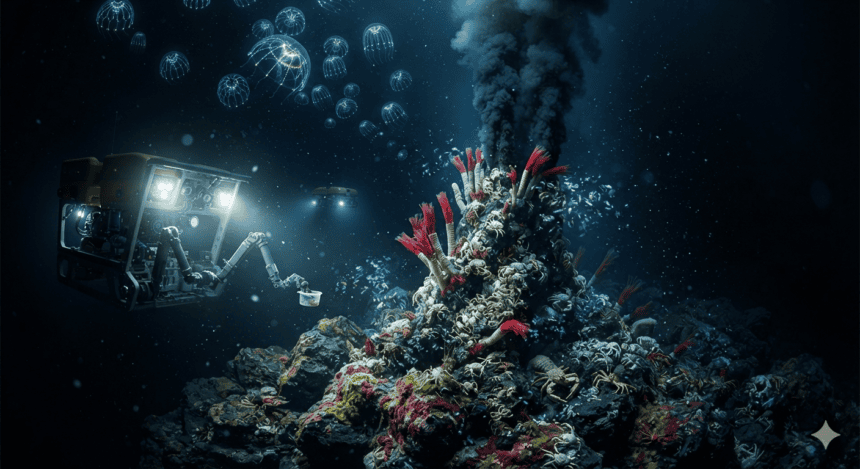
Scientists have uncovered remarkable new details about the hidden ecosystems beneath the ocean’s surface, revealing that the deep sea is home to an extraordinary diversity of life, much of which remains unexplored.
Using advanced technologies such as remotely operated underwater vehicles (ROVs), autonomous submarines, and high-resolution sonar mapping, researchers have been able to explore regions thousands of meters below sea level that were previously inaccessible. These missions have led to the discovery of previously unknown species, underwater mountains, hydrothermal vents, and complex habitats thriving in complete darkness.
Marine biologists say the deep ocean is one of the least understood environments on Earth. Despite covering more than 70% of the planet’s surface, scientists estimate that a large portion of the ocean floor has yet to be thoroughly explored.
Among the most significant discoveries are ecosystems surrounding hydrothermal vents, where organisms survive without sunlight by relying on chemicals released from the Earth’s interior. These unique environments host giant tube worms, unusual crustaceans, deep-sea fish, and countless microorganisms that have adapted to extreme temperatures and immense water pressure.
Researchers believe studying these hidden ecosystems could help answer important questions about the origins of life on Earth and even provide clues about the possibility of life on other planets with subsurface oceans, such as Jupiter’s moon Europa and Saturn’s moon Enceladus.
Scientists also warn that these fragile ecosystems face growing threats from climate change, plastic pollution, deep-sea mining, and ocean acidification. They emphasize that protecting deep-sea habitats is essential for preserving marine biodiversity and maintaining the health of the world’s oceans.
Experts hope continued exploration will uncover even more unknown species and improve our understanding of how deep-sea ecosystems influence global climate, carbon storage, and ocean circulation.
The latest discoveries highlight that Earth’s oceans still hold countless mysteries, making marine exploration one of the most exciting frontiers of modern science.