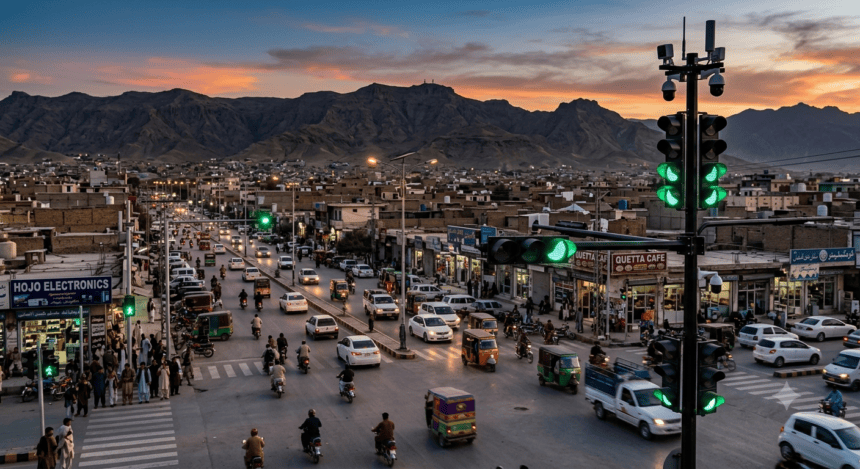
Quetta’s notorious traffic congestion is set for a digital overhaul. The provincial government has greenlit the installation of Artificial Intelligence-integrated traffic signals across the city’s busiest intersections, aiming to replace outdated, timer-based systems with real-time responsive technology.
The project shifts the city’s traffic management from static cycles to dynamic flow. Current signals operate on fixed intervals, regardless of whether a road is packed or empty. The new AI sensors will monitor vehicle density, adjusting green-light durations on the fly to clear bottlenecks before they spiral into city-wide jams.
For the average commuter, this means less time idling at red lights. For the administration, it marks a pivot toward “smart city” infrastructure—an attempt to modernize a provincial capital that has long struggled with rapid urbanization and an aging road network.
“The existing system is blind to the actual flow of traffic,” an official from the Quetta Metropolitan Corporation said. “These sensors will see the volume, calculate the load, and prioritize lanes based on demand, not just a clock.”
The rollout begins at key transit points, including the Sariab Road and Jinnah Road corridors, where congestion often paralyzes movement for hours. Engineers are currently mapping high-density zones to calibrate the AI algorithms. The goal is to reduce travel time through the city center by at least 30% within the first six months of operation.
Challenges remain. Experts warn that technology alone won’t solve Quetta’s traffic woes if road encroachment and illegal parking continue unchecked. The effectiveness of the AI sensors depends heavily on lane discipline—a persistent issue in a city where vehicles frequently ignore road markings.
The project is slated for a phased launch, starting with a pilot program at five major intersections before a full-scale deployment next year. If the sensors hold up under the city’s unique traffic patterns, Quetta could finally see an end to the gridlock that has defined its streets for decades.