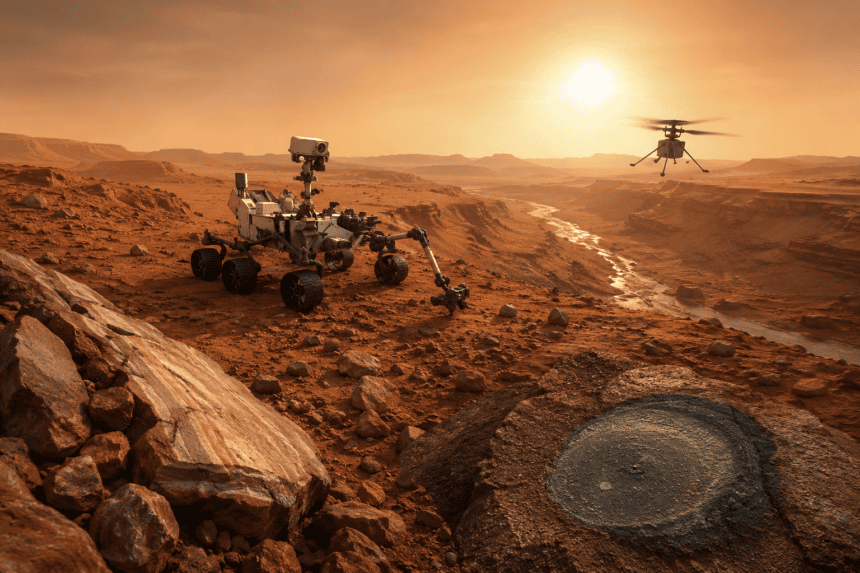
New discoveries on Mars are bringing scientists closer to understanding the Red Planet’s ancient history, offering fresh evidence about its climate, geology, and the possibility that it once supported conditions suitable for life.
Recent observations from Mars rovers, orbiters, and advanced scientific instruments have revealed new details about ancient riverbeds, sedimentary rocks, and mineral deposits that were formed billions of years ago. Researchers believe these features indicate that liquid water once flowed across large areas of the planet, creating lakes, rivers, and possibly shallow seas.
Scientists have also identified organic molecules and clay-rich rocks in several regions of Mars. While these findings do not confirm the existence of past life, they suggest that the planet may once have had an environment capable of supporting microbial organisms.
Geologists studying Martian rock samples say the minerals preserved within the rocks provide valuable clues about the planet’s changing climate. Evidence indicates that Mars was once warmer and wetter before gradually losing much of its atmosphere, eventually becoming the cold, dry world seen today.
Researchers are using data collected by robotic explorers to reconstruct Mars’ geological history and determine when major environmental changes occurred. Future sample-return missions are expected to provide even more detailed information by bringing Martian rocks back to Earth for laboratory analysis.
Scientists emphasize that understanding Mars is important not only for learning about our neighboring planet but also for gaining insights into the evolution of rocky planets across the Solar System, including Earth.
Experts believe the latest discoveries will help guide future human exploration of Mars while bringing humanity one step closer to answering one of science’s biggest questions: Did life ever exist on the Red Planet?