New paleontological research is shedding light on the Middle Jurassic Period, a crucial chapter in Earth’s history when giant dinosaurs began to dominate terrestrial ecosystems. Spanning approximately 174 to 163 million years ago, this era witnessed the rapid evolution and diversification of many dinosaur groups that would later become some of the largest animals ever to walk the planet.
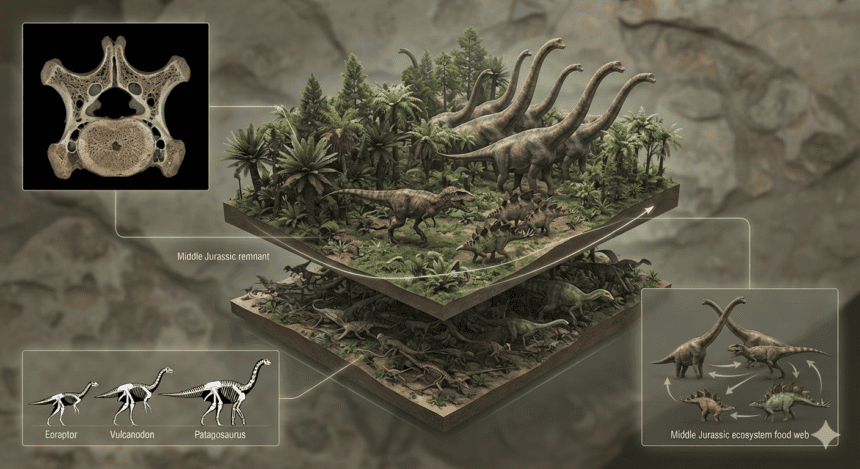
Researchers examined fossil remains, ancient rock formations, and trace fossils from sites across Europe, Asia, Africa, and South America. Using CT scanning, 3D digital reconstruction, and geological dating techniques, scientists reconstructed the environments in which these prehistoric giants lived.
The study reveals that the Middle Jurassic marked the rise of enormous sauropods, including the ancestors of later giants such as Brachiosaurus and Diplodocus. These long-necked herbivores evolved larger bodies, stronger limbs, and more efficient feeding strategies, allowing them to thrive in forests rich with conifers, cycads, and ferns.
At the same time, large theropod predators became increasingly specialized. Their powerful jaws, sharp teeth, and improved mobility enabled them to hunt the growing populations of massive herbivores that inhabited prehistoric landscapes.
Scientists also found evidence that warmer climates, abundant vegetation, and the gradual breakup of the ancient supercontinent Pangaea created new habitats and encouraged dinosaur diversification. These environmental changes played a major role in shaping Jurassic ecosystems.
The research highlights significant advances in dinosaur anatomy during this period, including stronger skeletons, improved locomotion, and adaptations that supported gigantic body sizes. These evolutionary developments laid the foundation for the dominance of dinosaurs throughout the Late Jurassic and Cretaceous periods.
Experts say the Middle Jurassic remains one of the least understood intervals of dinosaur evolution, making every new fossil discovery especially valuable. Continued excavations and modern imaging technologies are expected to reveal even more about the animals that transformed Earth’s prehistoric world.