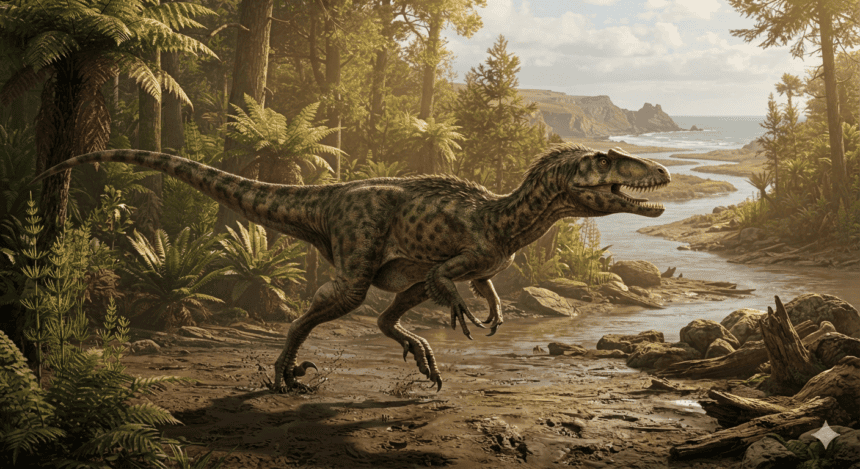
Eustreptospondylus was a fast and agile carnivorous dinosaur that lived during the Middle Jurassic Period, around 165 million years ago. Fossils discovered in southern England have made it one of Britain’s most important predatory dinosaurs, offering valuable insights into the early evolution of large theropods.
Measuring approximately 5 to 6 meters (16–20 feet) in length, Eustreptospondylus possessed powerful hind legs, sharp serrated teeth, strong jaws, and a long balancing tail. These features made it an efficient hunter capable of chasing small to medium-sized dinosaurs and other prehistoric animals.
Recent fossil research using CT scanning, 3D digital reconstruction, and biomechanical analysis has revealed new details about its skull structure, limb mechanics, and hunting adaptations. Scientists believe it combined speed with strength, allowing it to ambush prey in the forests and coastal environments of Jurassic Britain.
Researchers also found that Eustreptospondylus belonged to an important stage in theropod evolution, displaying a mixture of primitive and more advanced skeletal characteristics. These features help scientists trace how later giant predators evolved during the Jurassic and Cretaceous periods.
Fossil evidence suggests that this dinosaur inhabited river valleys, coastal lagoons, and forested regions, where it likely competed with other carnivorous reptiles for food. Its keen senses and agile body would have made it one of the top predators in its ecosystem.
Experts say continued discoveries of Jurassic fossils in Britain are expanding our understanding of dinosaur diversity and the evolution of early meat-eating dinosaurs.