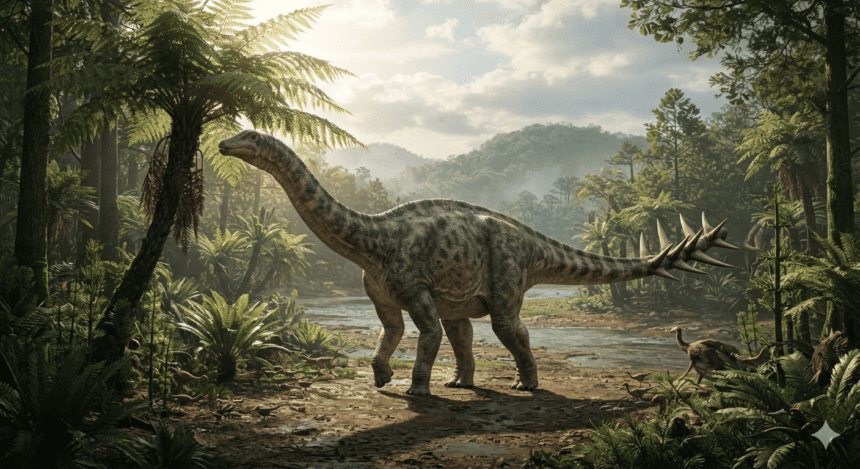
Shunosaurus was a remarkable long-necked dinosaur that lived during the Middle Jurassic Period, approximately 170 million years ago. Unlike most other sauropods, Shunosaurus possessed a unique club-like armored tail, making it one of the few giant herbivorous dinosaurs known to have an active defensive weapon.
Fossils discovered primarily in China’s Sichuan Province have provided scientists with exceptionally well-preserved skeletons, allowing researchers to study its anatomy, movement, and evolutionary history in remarkable detail.
Shunosaurus measured around 9 to 10 meters (30–33 feet) in length and weighed several tons. It had a relatively shorter neck than many later sauropods, a sturdy body, pillar-like legs, and a long tail ending in a bony club covered with protective spikes.
Recent studies using CT scanning, 3D digital reconstruction, and biomechanical analysis suggest that the tail club could have been used to defend against large predatory dinosaurs. Scientists believe powerful swings of the tail were capable of delivering forceful blows to attackers.
Researchers also found that Shunosaurus fed primarily on low-growing vegetation such as ferns, horsetails, and conifer branches. Its spoon-shaped teeth were well suited for stripping leaves, while its large digestive system helped process tough plant material.
Experts consider Shunosaurus an important species for understanding the early evolution of sauropods. Its unusual combination of gigantic size and defensive adaptations provides valuable insight into how herbivorous dinosaurs survived alongside powerful Jurassic predators.
Scientists say ongoing fossil discoveries continue to improve our understanding of Jurassic ecosystems and the extraordinary diversity of dinosaurs that once roamed ancient Earth.