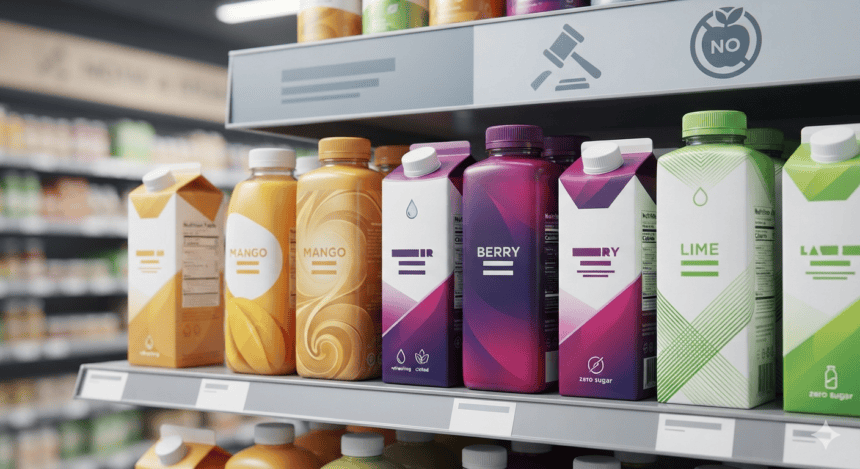
The National Assembly’s Standing Committee on Science and Technology has directed the Pakistan Standards and Quality Control Authority (PSQCA) to prohibit the use of fruit imagery on packaging for synthetic, flavored beverages. The move aims to curb misleading marketing that leaves consumers believing these products contain real fruit juice.
Lawmakers on the committee argued that the current labeling practices are deceptive. Bottles and cartons often feature high-definition photos of oranges, mangoes, or apples, despite the contents being composed almost entirely of artificial flavoring, sugar, and preservatives.
Committee members emphasized that the current branding strategy exploits consumer trust. Parents frequently purchase these drinks for children under the assumption they are consuming a natural fruit product. In reality, many of these “nectars” or “drinks” contain less than 10 percent real fruit content—or none at all.
The PSQCA has been tasked with drafting new regulations to enforce this ban. The directive requires that any product lacking a significant percentage of natural fruit pulp must feature a clear, text-based label identifying it as a “flavored drink” or “artificial beverage.” Any visual representation of fresh produce on the front of the packaging will be strictly prohibited.
Industry representatives are expected to push back. For years, beverage companies have relied on vibrant fruit imagery to drive sales in a crowded market. Replacing these designs will likely trigger significant rebranding costs for major players in the local food and beverage sector.
The committee’s decision follows a series of complaints regarding the transparency of food labeling in Pakistan. While the directive is a first step, the challenge remains in enforcement. With a history of inconsistent implementation regarding food safety standards, the efficacy of this ban will depend on how quickly the PSQCA can audit the market and penalize non-compliant manufacturers.
For now, the mandate serves as a sharp warning to the industry: the days of using photographic illusions to sell chemical concoctions as fruit juice are numbered.