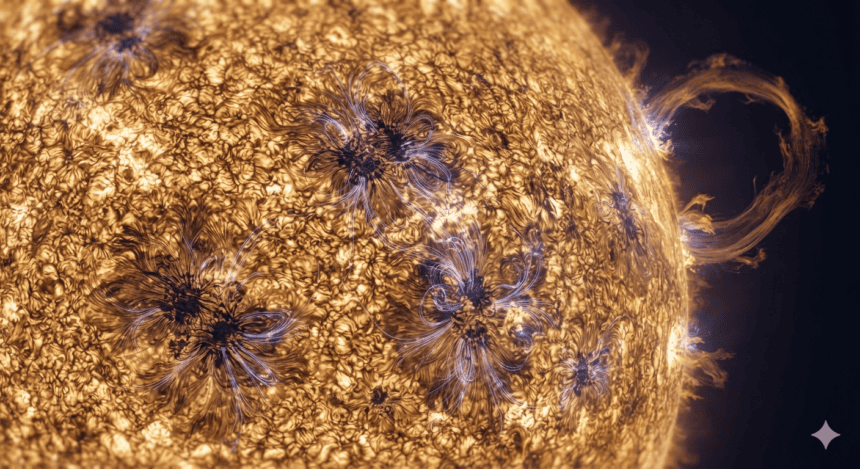
The sun’s surface is now visible with more clarity than ever before. Astronomers using the Daniel K. Inouye Solar Telescope have captured images that resolve features as small as 18 kilometers across, offering a glimpse into the chaotic magnetic activity churning in the solar atmosphere.
These images aren’t just high-resolution snapshots. They map the complex magnetic fields and plasma motions that drive space weather—the same solar outbursts capable of knocking out power grids and satellite communications here on Earth. By tracking these movements, researchers are gaining a better understanding of how the sun heats its outer atmosphere, the corona, to temperatures millions of degrees hotter than the surface itself.
The data reveals “sunspots” not as static dark patches, but as dynamic, shifting structures. The images show plasma flowing in convection cells—the churning granules that act like a pot of boiling water on a stove. Each granule is roughly the size of a large city, yet they represent only a tiny fraction of the sun’s massive energy output.
For decades, scientists relied on lower-resolution data that blurred these granular structures. The Inouye telescope, located on the island of Maui, uses a four-meter primary mirror to bypass atmospheric interference, providing a sharper view of the solar photosphere. This leap in technology allows teams to observe the “magnetic braiding” that precedes solar flares.
The implications extend far beyond solar physics. Understanding these patterns helps space agencies predict geomagnetic storms with greater accuracy. A major solar event could cause billions of dollars in damage to global infrastructure; these images provide the raw, granular data needed to refine the models used to forecast those risks.
As the sun approaches the peak of its current 11-year cycle, this level of observation is critical. Scientists are no longer just watching the sun; they are mapping the intricate, violent mechanics of the star that dictates the climate and technological stability of our entire solar system.