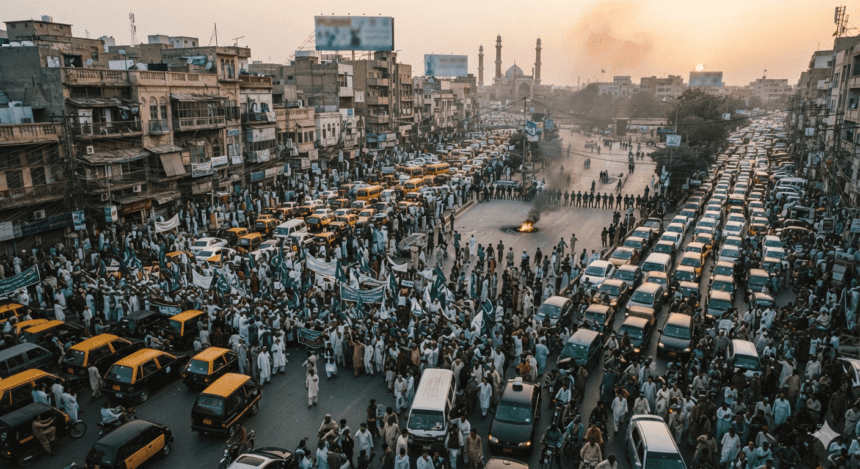
Karachi’s main traffic arteries ground to a halt today as Jamaat-e-Islami (JI) activists staged sit-ins across the city. The protests—organized to demand a rollback of recent electricity tariff hikes and a reduction in fuel prices—left thousands of commuters trapped in gridlock during the peak evening rush.
The impact hit hardest at the Numaish Chowrangi intersection, a central hub connecting the city’s east and west. By 4:00 PM, demonstrators had blocked the main corridor, creating a ripple effect that jammed roads reaching into Saddar, Shahrah-e-Faisal, and University Road.
For the average Karachiite, the protest meant more than just a delay. Delivery riders, office workers, and students spent hours idling in the heat.
“I’ve been stuck near M.A. Jinnah Road for ninety minutes,” said Ahmed Khan, a logistics driver trying to navigate the blockade. “I’m losing my daily wage by the hour, and there’s no way to turn around.”
JI leadership claims the blockades are a necessary response to the federal government’s fiscal policies. Hafiz Naeem-ur-Rehman, the party’s provincial chief, told supporters gathered at the site that the party won’t budge until the state addresses the “crushing burden” of utility bills. He framed the disruption as a struggle for the common citizen’s survival, rather than a mere political demonstration.
Traffic police struggled to manage the chaos. Officers redirected vehicles into narrow residential lanes, which quickly became overwhelmed. By sunset, the gridlock had spilled over into secondary roads, effectively cutting off access to several major hospitals in the city center.
While the police presence was heavy, authorities avoided direct confrontation. A senior traffic official, speaking on condition of anonymity, admitted that clearing the protesters by force would likely trigger further unrest in an already tense city.
The protests are expected to continue through the evening, with the party hinting at a broader shutdown if their demands aren’t met by the end of the week. For now, the city remains at a standstill—a recurring reality for Karachi, where political agitation consistently takes precedence over the flow of daily life.