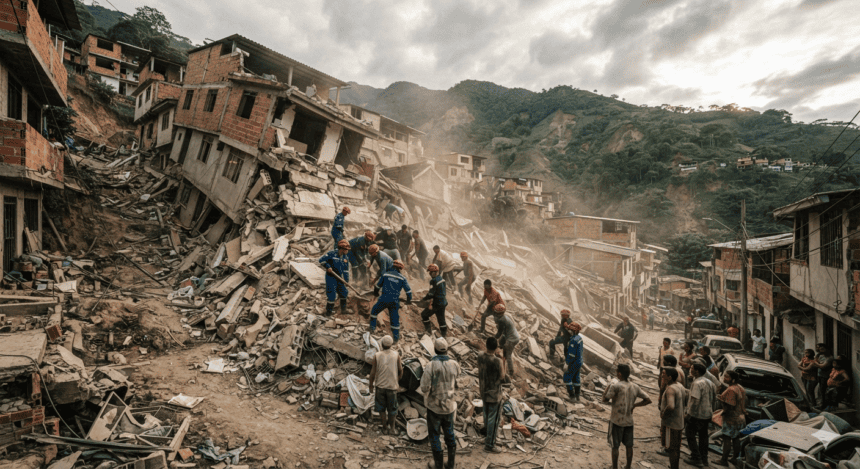
A powerful 7.4-magnitude earthquake struck western Colombia early this morning, sending thousands of residents into the streets and triggering widespread alarm across the Andean region. The tremor, centered near the mountainous department of Chocó, hit at a depth of 10 kilometers, according to the Colombian Geological Service.
The force of the quake was felt acutely in major urban hubs, including Medellín and the capital, Bogotá. High-rise office buildings and residential towers swayed for nearly 40 seconds, prompting immediate evacuations. In downtown Medellín, employees huddled in open plazas as public transit systems halted operations to allow for safety inspections.
Local authorities in Chocó have initiated emergency protocols. While initial reports from the National Unit for Disaster Risk Management (UNGRD) indicate structural damage to older masonry buildings in rural districts, the full extent of the impact remains obscured by mountainous terrain and damaged communication lines. Rescue teams are currently deploying to the epicenter to assess potential casualties.
“The shaking didn’t stop. It felt like the ground was moving in waves,” said a resident in Quibdó, the capital of Chocó.
Infrastructure remains a primary concern. The Ministry of Transport confirmed that several secondary highways in the region are blocked by landslides—a common secondary hazard in this geography. Engineering crews are working to clear debris, but officials warn that aftershocks could trigger further instability in the saturated soil.
Colombia sits on a complex tectonic intersection, where the Nazca, Caribbean, and South American plates meet. While seismic activity is frequent, a 7.4-magnitude event ranks as a significant stress test for the country’s building codes, which were substantially tightened following the devastating 1999 Armenia earthquake.
The government has declared a state of alert for the affected departments. For now, the focus is on search and rescue operations in the harder-to-reach rural zones, where the lack of modern infrastructure could amplify the disaster’s footprint. Officials expect to have a clearer picture of the human and economic toll by daybreak.