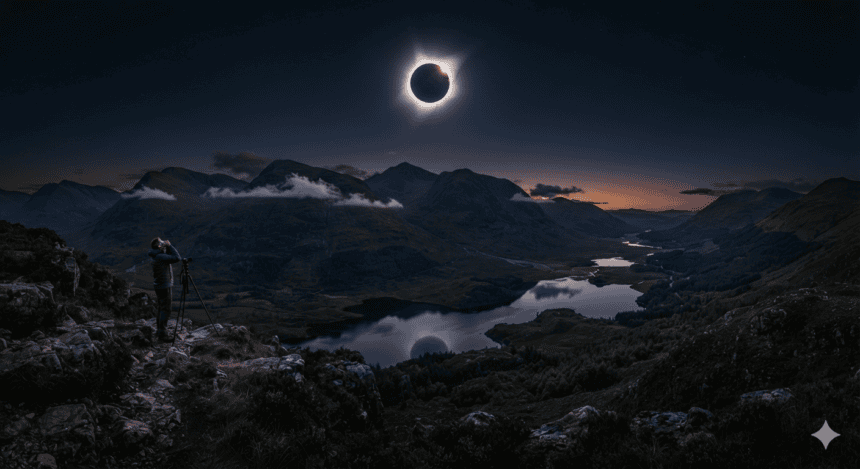
Scotland is set for a celestial display on March 29, 2025, as a partial solar eclipse tracks across the northern hemisphere. While much of the world will focus on the path of totality elsewhere, observers across the UK—and particularly in Scotland—will see the moon take a distinctive bite out of the sun.
The event begins in the late morning. For those in Edinburgh and Glasgow, the spectacle starts around 10:50 GMT. The moon will gradually obscure the sun, reaching its maximum coverage shortly after 11:30 GMT. By 12:15 GMT, the moon will have moved clear, leaving the sun fully visible once again.
Don’t expect the sky to go dark. This is a partial eclipse, meaning the sun will remain the dominant feature. At the peak, the moon will cover roughly 30% to 40% of the sun’s disc depending on your exact latitude. The further north you are—think Inverness or the Highlands—the greater the percentage of the sun will be obscured.
Cloud cover remains the primary threat to any astronomical event in Scotland. Meteorologists suggest the late-March window is notoriously fickle, though the timing offers a decent chance of clear patches if a high-pressure system settles over the North Sea.
“The geometry is straightforward, but the weather is the real variable,” said an astronomer with the Royal Observatory. “You don’t need a telescope to see this, but you do need the right precautions.”
Eye safety is the non-negotiable rule. Standard sunglasses offer zero protection against solar radiation. Looking directly at the sun—even when partially obscured—can cause permanent retinal damage. Proper solar filters or eclipse glasses are the only safe way to view the event. If you don’t have filters, a simple pinhole projector made from two pieces of card will cast a safe, projected image of the eclipse onto the ground.
This marks the first significant solar event visible from Scotland since the partial eclipse of October 2022. While the 2025 event lacks the drama of a total blackout, it serves as a rare mid-morning reminder of the precise, clockwork movement of our solar system.
If the clouds hold, look up just before noon. You won’t see a total eclipse, but you will see the sun momentarily reshape itself.