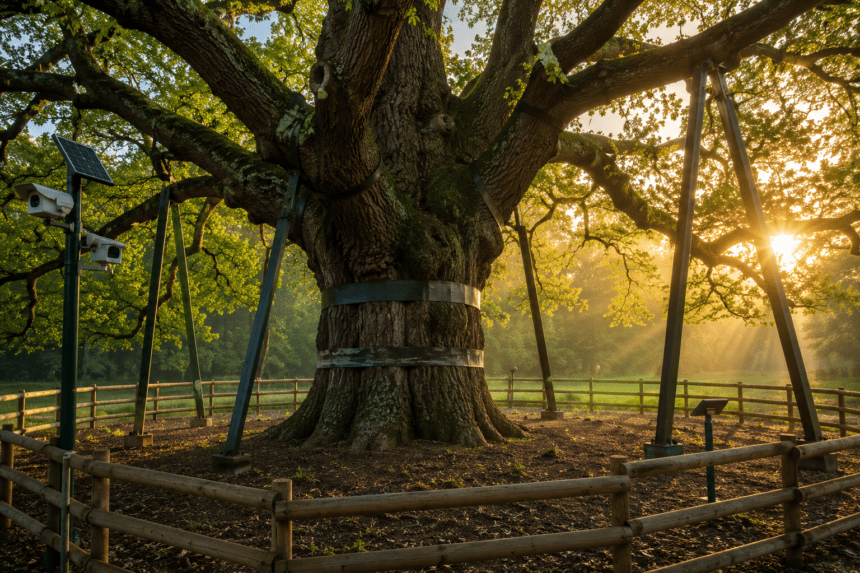
Crews began installing a new perimeter fence and aerating the soil around the town’s historic oak today, a move experts say is years overdue.
Decades of foot traffic have packed the earth around the base into a concrete-like layer. It’s suffocating the roots. Without these measures, the tree — a local landmark since the late 1700s — might not survive another decade.
The conservation plan involves “air-spading,” a process that uses high-pressure air to loosen soil without damaging delicate root fibers. Workers will then backfill the area with nutrient-rich organic mulch to jumpstart the tree’s health.
“We aren’t just putting up a fence for show,” said Mark Hedges, the lead arborist on the project. “We’re creating a biological buffer. If people keep walking over the root zone, the tree simply can’t drink.”
The project costs $45,000, funded mostly by a state heritage grant. It follows a narrow escape last autumn when a heavy limb snapped during a thunderstorm, narrowly missing a nearby walkway. That incident prompted an immediate structural audit, which revealed the tree was struggling to support its own weight due to poor nutrient uptake.
Some residents have complained the new iron fencing ruins the park’s open aesthetic. Others see it as a small price to pay for a living piece of history.
The work should wrap up by Friday. For now, the heavy machinery is gone, leaving the old oak behind its new barrier. It’s a quiet start to what arborists hope will be a long recovery.