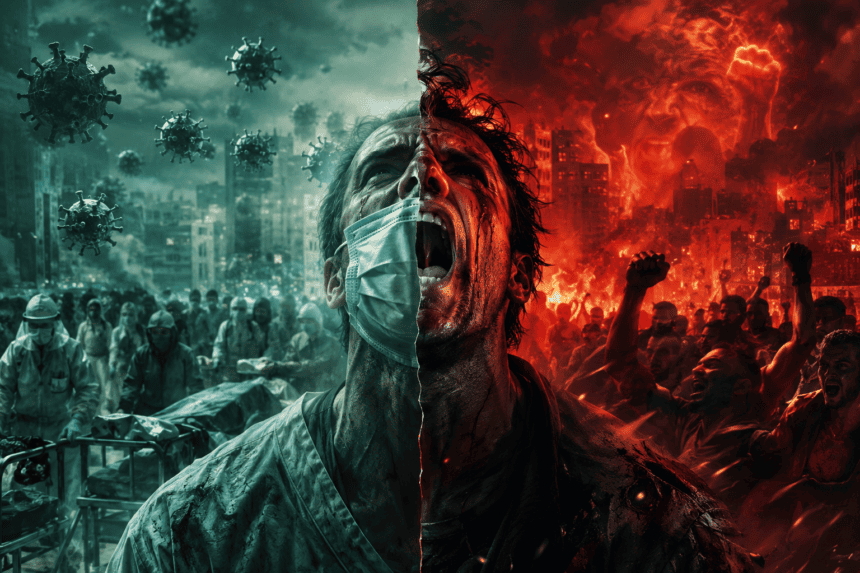
Public health crises rarely stay confined to hospitals and labs. Throughout history, the arrival of a pathogen—whether bubonic plague or COVID-19—has acted as a chemical accelerant for social volatility. When people feel physically threatened, their trust in institutions plummets, and the resulting friction often spills into the streets.
The pattern is stark. As infection rates climb, so does the public’s propensity for civil disobedience. Sociologists point to the “crisis-fatigue” cycle: initial fear gives way to confusion, which then hardens into resentment toward whoever holds the power. When governments impose lockdowns or mandates, the frustration isn’t just about the rules; it’s about the loss of agency during a period of existential dread.
“Disease doesn’t just attack the body; it attacks the social contract,” says Dr. Elena Vance, a sociologist tracking mass behavior during outbreaks. “When the state can no longer provide safety, the psychological fallback is anger. People look for a target, and they find it in the halls of power.”
Data from the last five years supports this. Regions with the most stringent health restrictions saw a measurable spike in political polarization and protests. It isn’t merely a reaction to the policy itself, but a manifestation of collective helplessness. When the invisible threat becomes the defining feature of daily life, the visible structures of society become the lightning rod for all that pent-up anxiety.
This rage rarely remains focused on health policy. It bleeds into existing economic grievances. Inflation, supply chain failures, and the widening wealth gap—all exacerbated by epidemics—act as fuel. When a citizen can’t afford groceries because of a disrupted economy, their anger toward a mask mandate is often a proxy for their anger toward a collapsing standard of living.
History suggests this cycle won’t break until the threat retreats. During the 1918 flu pandemic, the political fallout was delayed but profound, contributing to the radical shifts in governance seen in the decade that followed. We are seeing a compressed version of that today.
As long as the fear of illness persists, the public’s temperature will remain elevated. Governments that attempt to manage this through force or suppression often find that they are only squeezing a balloon; the pressure simply forces the air into a different, more volatile part of the system.
The epidemic will eventually pass, but the rage it leaves behind will dictate the political climate for years to come.