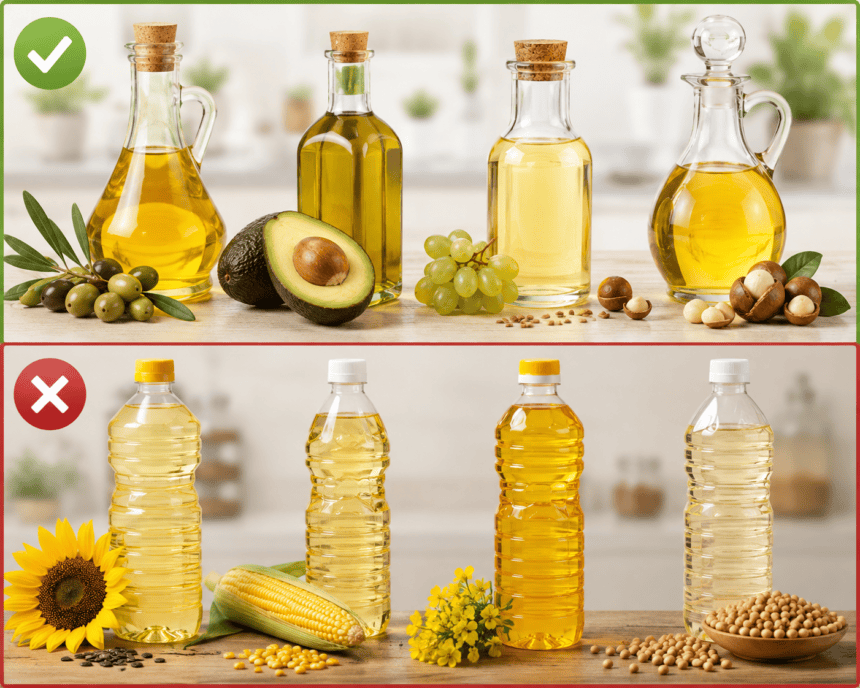
Cooking oil is an important part of many diets, but different oils contain different types of fats. Choosing oils that are higher in unsaturated fats can be a better option for everyday cooking.
4 Healthier Cooking Oils
1. Olive Oil
Olive oil is rich in monounsaturated fat and is a major component of the Mediterranean-style eating pattern. Extra-virgin olive oil also contains beneficial plant compounds.
2. Avocado Oil
Avocado oil is high in monounsaturated fat and can be useful for a variety of cooking methods.
3. Canola Oil
Canola oil contains relatively low amounts of saturated fat and provides unsaturated fats. It can be a practical option for everyday cooking.
4. Peanut Oil
Peanut oil contains mostly unsaturated fats and can be used for cooking at appropriate temperatures.
4 Oils to Limit
1. Coconut Oil
Coconut oil is very high in saturated fat. Because high saturated-fat intake can raise LDL cholesterol, it is generally better used in moderation.
2. Palm Oil
Palm oil contains a relatively high amount of saturated fat and is best limited when consumed frequently.
3. Butter as a Cooking Fat
Although butter is technically a dairy fat rather than a vegetable oil, it is high in saturated fat and should generally be used in moderation.
4. Partially Hydrogenated Oils
These are a major source of artificial trans fats, which are harmful to heart health. Products containing partially hydrogenated oils should be avoided.
Remember: Quantity Matters
Even healthier oils are calorie-dense, providing about 9 calories per gram. Choosing a healthier oil does not mean using unlimited amounts.
The Bottom Line: For everyday cooking, oils rich in unsaturated fats—such as olive, avocado, canola and peanut oils—can be better choices than fats high in saturated or trans fats.