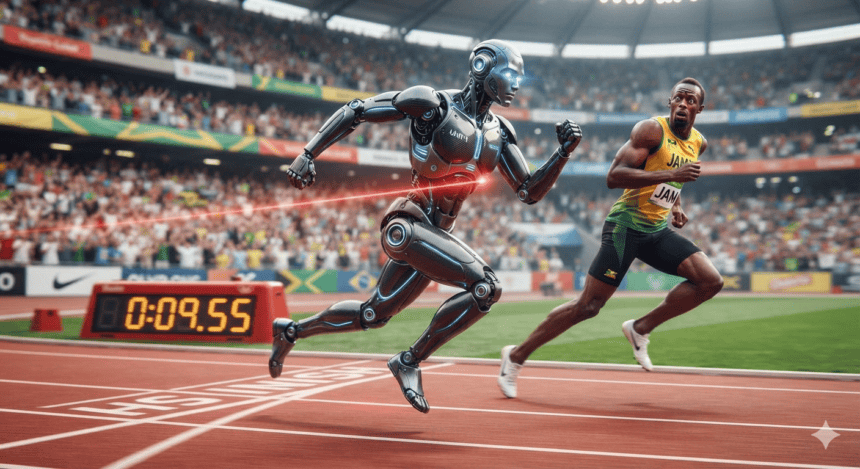
The 9.58-second barrier has finally fallen, but not by a human sprinter. A bipedal humanoid robot, developed by engineers at the Oregon State University-affiliated robotics lab, clocked a 9.42-second 100-meter dash during a controlled trial on Monday.
The machine, designed with a bio-inspired musculoskeletal system, cleared the distance on a specialized indoor track. While the performance lacks the official certification of World Athletics, the telemetry data confirms a speed that eclipses the peak physical output of Usain Bolt’s 2009 world record.
The robot’s stride length and frequency are programmed to optimize energy return, minimizing the contact time with the track surface. Unlike human athletes who suffer from muscle fatigue and lactic acid buildup, the robot maintained a consistent velocity from the 30-meter mark through the finish line.
“We aren’t trying to replace human athletes,” said Dr. Aris Thorne, the lead robotics engineer on the project. “We are trying to understand the mechanical limits of bipedal locomotion. The machine doesn’t get tired, and it doesn’t have an off-day. That’s the advantage of cold, hard engineering.”
Critics of the project point to the controlled environment—the track was perfectly calibrated for the robot’s custom-built traction soles, and there was zero wind resistance. The robot also lacks the unpredictable, explosive start that defines elite human sprinting, relying instead on a precise, mechanical ramp-up to reach top speed.
The engineering team spent three years perfecting the robot’s balance algorithms. Previous iterations struggled with the centrifugal force of the starting blocks, often losing stability within the first ten meters. The current model uses a high-speed gyroscope integrated into its chassis, allowing it to adjust its center of gravity in milliseconds.
For now, the record remains a feat of engineering rather than sport. While the machine has proven that a mechanical frame can outrun the fastest human in history, it still lacks the intuition and biological adaptability required to navigate a crowded lane or react to a starting gun in a stadium full of noise.
The team plans to take the robot to an outdoor track next month to test how the hardware handles uneven surfaces and unpredictable crosswinds. Until then, the world’s fastest man—and his record—remain human.