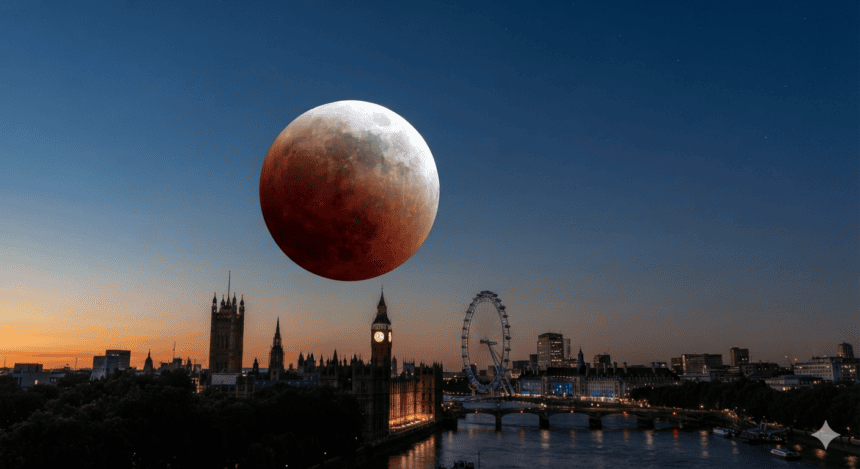
The moon will take on a reddish hue tonight as a partial lunar eclipse becomes visible across the United Kingdom. This celestial event occurs when the Earth passes between the Sun and the Moon, casting a shadow that obscures a portion of the lunar surface.
Unlike a total eclipse where the moon is completely swallowed by Earth’s shadow, this partial event will see only a “bite” taken out of the lunar disk. Observers in the UK can expect the peak of the eclipse to occur late in the evening, with the moon appearing slightly darkened and tinged with copper or rusty red tones.
The phenomenon is caused by Rayleigh scattering. As sunlight passes through Earth’s atmosphere, blue light is filtered out while longer, redder wavelengths are bent toward the moon. It’s the same physics that turns sunsets red, but here, the light is projected onto the lunar landscape.
“You don’t need a telescope for this,” said Dr. Sarah Jenkins, an astronomer at the Royal Observatory. “The naked eye is perfectly sufficient, provided the clouds stay away. Look for the moon to lose some of its brightness as the shadow creeps across the southern edge.”
Clear skies are the primary variable for viewers. While parts of the UK face intermittent cloud cover, those in western regions have a higher probability of an unobstructed view. The event begins as the moon enters the penumbra—the outer part of Earth’s shadow—before the more noticeable umbral shadow begins to darken the lunar surface.
This eclipse is the latest in a series of lunar events this year, but it remains a rare opportunity for casual stargazers to witness a significant alignment. Astronomers note that while the “blood moon” effect is often associated with total eclipses, the partial variety offers a distinct, subtle contrast that is equally striking.
The eclipse will reach its maximum coverage shortly before midnight. For those hoping to catch the full progression, the entire process will last several hours, starting with a faint dimming that most will miss until the shadow becomes unmistakable.
Whether the sky remains clear will determine if the UK gets a full view of the spectacle, but for many, the simple act of looking up at the precise moment of alignment provides a rare window into the mechanics of our solar system.