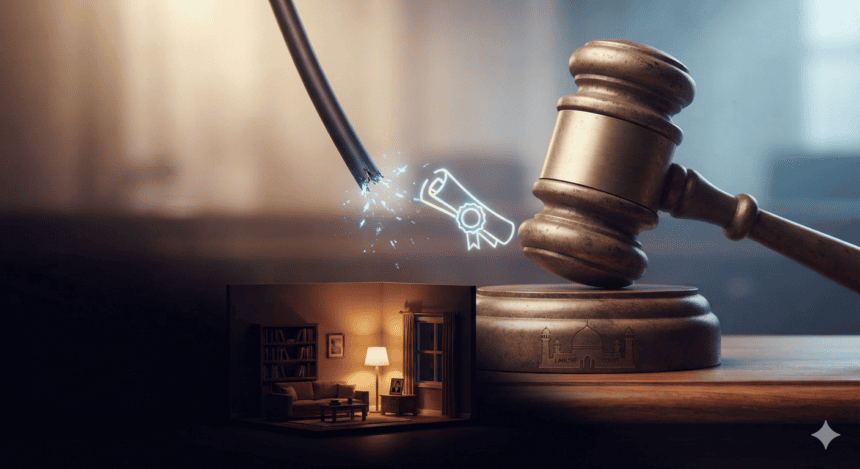
The Lahore High Court has struck down the practice of disconnecting domestic electricity connections without prior notice, declaring the move a violation of consumer rights. Justice Shahid Karim delivered the verdict Tuesday, mandating that power distribution companies (DISCOs) must now provide a formal hearing to consumers before cutting off supply due to non-payment.
For years, electricity providers across Punjab have relied on immediate disconnection as a standard collection tactic. The court’s ruling shifts the burden back onto the utility companies, stripping them of the power to act as both judge and jury.
“The authority cannot exercise arbitrary power to penalize a consumer without due process,” the court noted in its written order. The judge emphasized that electricity is an essential service, and summary disconnection by DISCOs often leaves families in precarious positions without recourse.
The petition, filed by a group of domestic consumers, argued that power companies frequently ignore billing errors and meter malfunctions, opting instead to pull the plug first and address complaints later. Under the new directive, DISCOs must issue a show-cause notice and allow the consumer a reasonable window to contest the bill or explain the delay before any physical disconnection takes place.
Legal experts view this as a significant check on the unchecked autonomy of power distribution companies. Previously, consumers fighting inflated bills or faulty meter readings were often forced to pay the disputed amount just to restore power, only to spend months chasing a refund that rarely materialized.
The court has directed the Ministry of Energy and the National Electric Power Regulatory Authority (NEPRA) to ensure compliance across all distribution companies. While the ruling applies immediately, the real test will be how strictly the utility companies adhere to the new notification protocols.
For now, the era of “disconnect first, talk later” has effectively come to an end in the jurisdiction of the Lahore High Court. Whether this forces a more transparent billing system or simply creates a new bureaucratic hurdle for DISCOs remains the next point of contention.