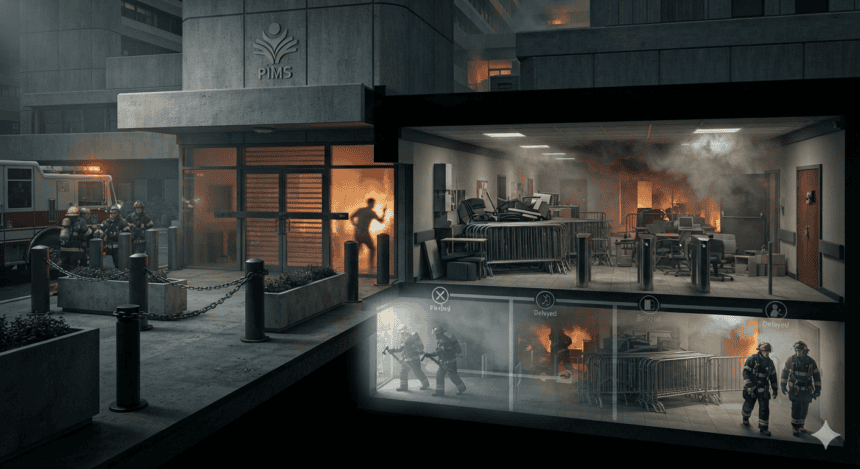
The fire that broke out at the Pakistan Institute of Medical Sciences (PIMS) last week could have been contained far earlier if not for systemic security failures. An internal inquiry report, obtained by investigators, reveals that rescue teams spent critical minutes battling locked gates and unauthorized concrete barriers rather than the flames themselves.
When the first emergency crews arrived at the hospital’s main entrance, they were met with chains and padlocks. Security staff, caught in a cycle of confusion, struggled to locate keys as smoke began to billow from the pediatric ward.
For the firefighters, those minutes were costly. The delay allowed the blaze to spread through the ventilation ducts, forcing a chaotic evacuation of patients already in critical condition. Hospital management had prioritized perimeter security over emergency access, leaving the facility’s own safety protocols dead on arrival.
“We were essentially locked out of a burning building,” one senior rescue official said, speaking on condition of anonymity. “You can have the best equipment in the city, but it’s useless if you can’t get the trucks through the front door.”
The report details a “siloed” security culture at PIMS. Private security contractors, acting under strict—and often rigid—orders to control foot traffic, had failed to coordinate with the hospital’s own maintenance team regarding fire exit accessibility. Concrete blocks, installed months ago to deter unauthorized parking, effectively turned the hospital’s service entry into a bottleneck that blocked heavy fire engines.
Hospital administration officials have since scrambled to issue a defense, blaming the “security climate” for the tightened access points. They argue that the measures were necessary to prevent theft and unauthorized entry, a recurring issue at the capital’s largest public hospital.
Yet, the inquiry paints a different picture of priorities. It suggests that while the administration focused on controlling the crowd, they neglected the reality that a hospital is a high-risk zone for fire.
The findings are now being reviewed by the Ministry of Health, with calls for an immediate overhaul of safety protocols at all major government hospitals. For the patients who were rushed into the night air during the blaze, the investigation offers little comfort. It confirms that the greatest threat to their safety wasn’t just the fire—it was the very walls meant to protect them.