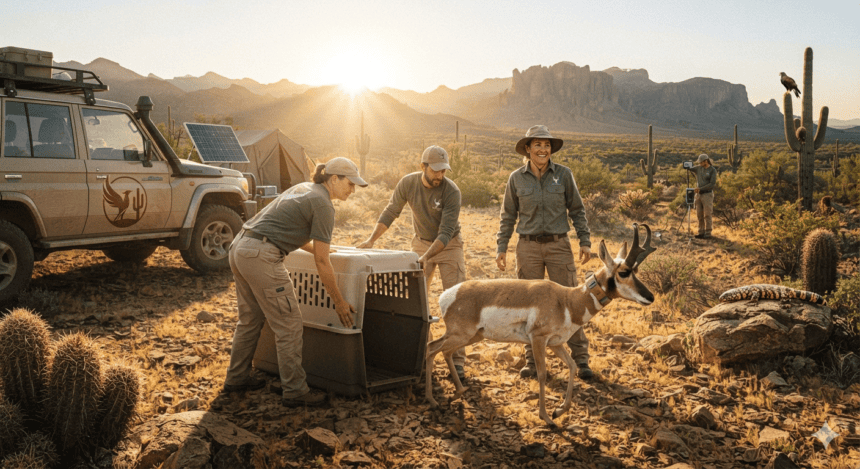
The Phoenix Species Project has launched a major funding cycle aimed at reversing the decline of critically endangered wildlife, injecting capital into field research that has long been sidelined by budget constraints. The initiative focuses on species currently teetering on the edge of extinction, prioritizing data-driven conservation over speculative recovery plans.
Conservationists have struggled for years to secure consistent funding for “non-charismatic” species—animals that lack the popular appeal of tigers or elephants but are vital to ecosystem stability. This project changes that calculus. By funding rigorous monitoring and habitat restoration, the organization aims to stabilize populations before they reach the point of no return.
“We aren’t just throwing money at a problem,” said Sarah Jenkins, the project’s lead biologist. “We’re funding the boots on the ground—the people who track population shifts and identify exactly why these species are failing.”
The funding strategy relies on a tiered system. High-risk areas, particularly in Southeast Asia and sub-Saharan Africa, will receive the bulk of the initial grants. The project requires researchers to submit quarterly performance reports, a shift from the traditional academic model that often delays real-world application of findings.
Critics of such initiatives often point to the high failure rate of species reintroduction programs. To counter this, the Phoenix Species Project has partnered with local governments to ensure that legal protections for habitat land are enacted alongside the research. Without land security, the project leaders argue, the research is little more than a post-mortem.
The initiative marks a pivot toward accountability in the conservation sector. By stripping away the bureaucratic layers that typically consume donor funds, the project hopes to prove that direct investment in field research can outpace the rate of habitat destruction.
Whether this model can scale remains the central question for the organization. For now, the first round of grants is already being processed, with field teams expected to begin work in early spring. Success will be measured not by the number of studies published, but by the measurable uptick in population counts over the next twenty-four months.