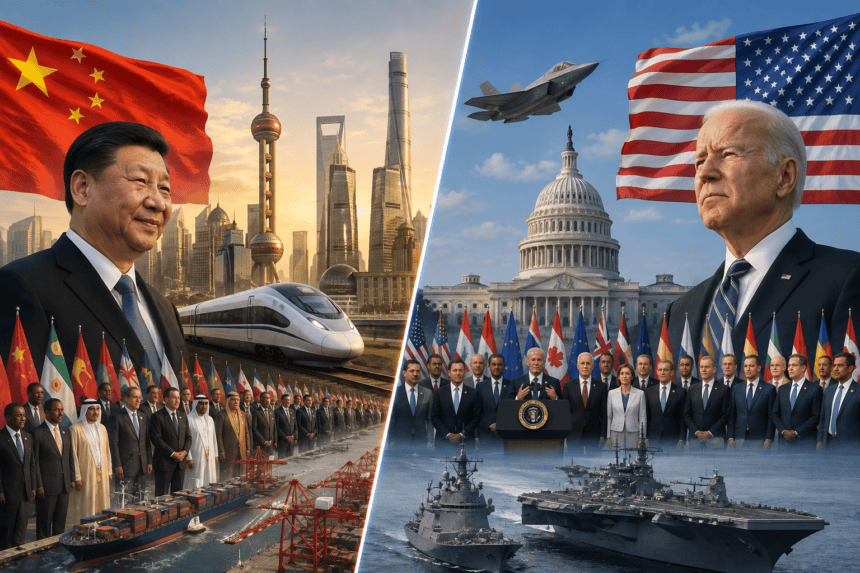
The world’s two largest economies are currently engaged in a high-stakes beauty contest, and the stage is set in two different corners of the globe. This week, Washington and Beijing are hosting major international gatherings, each attempting to frame a vision for the global order that excludes the other.
In Washington, the U.S. is pushing its traditional alliance-based architecture. President Biden’s administration is focusing on security pacts, technology export controls, and strengthening ties with Indo-Pacific partners. The message is clear: the U.S. remains the anchor of the existing rules-based system, despite internal political turbulence and a polarized electorate.
Across the Pacific, China is hosting its own showcase. Beijing is leaning into its “Global South” narrative, emphasizing infrastructure investment, non-interference, and trade frameworks that bypass the U.S. dollar. For leaders in the Global South, China’s pitch is simpler: growth without the baggage of Western political conditions.
The contrast is sharp. Washington’s meetings are heavy on security guarantees and democratic values. Beijing’s forums prioritize economic development and logistical connectivity.
“We aren’t asking countries to choose,” a senior U.S. diplomat said during a briefing Tuesday, though the reality on the ground suggests otherwise. Every bilateral agreement signed in D.C. carries an implicit expectation of alignment, just as every infrastructure loan from Beijing carries a silent assumption of diplomatic support.
The “so what” for the rest of the world is stark. Smaller nations are finding themselves in the middle of a massive tug-of-war. They face a choice between the security umbrella of the U.S. and the massive, cash-rich economic engine of China. It’s a binary trap that many developing states are trying to navigate by hedging their bets, playing both sides to maximize their own national interests.
For the U.S., the challenge is sustaining momentum while managing domestic fatigue over foreign commitments. For China, the hurdle is maintaining economic growth as its own domestic property and debt crises loom large.
As the summits conclude, the result won’t be a clear winner. Instead, the world is watching a slow-motion fracturing of the global consensus. The era of a single dominant superpower is over, and both Washington and Beijing are now busy cementing the foundations of a divided future.