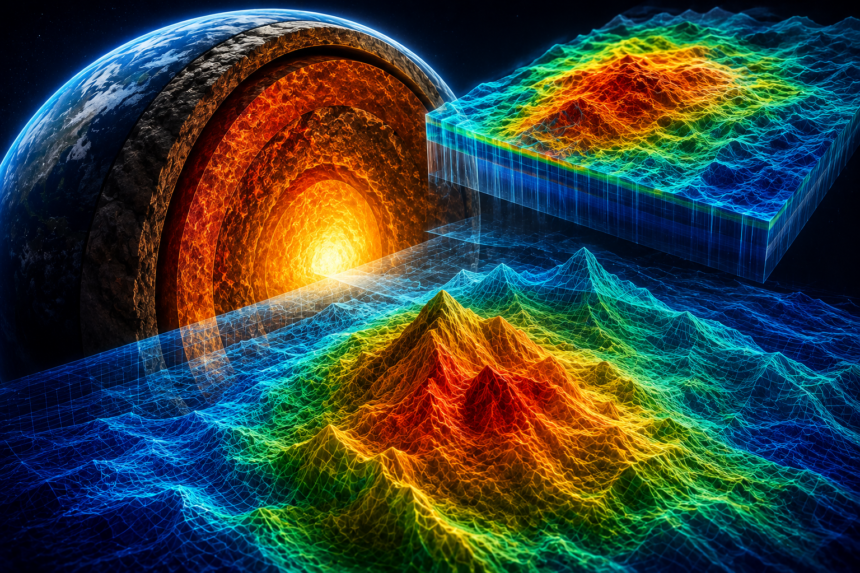
Geologists have unveiled a high-resolution map of the Earth’s deep mantle, a feat previously thought impossible due to the sheer density and inaccessibility of the planet’s interior. Researchers at the University of Cambridge utilized a novel machine learning algorithm to process decades of seismic wave data, effectively creating an “ultrasound” of the Earth’s internal structure.
The breakthrough centers on how seismic waves—triggered by earthquakes—travel through the planet. Standard imaging techniques often struggle to distinguish between subtle temperature variations and chemical anomalies deep underground. The new AI model, however, filters out background noise and reconstructs the mantle’s composition with unprecedented clarity.
This mapping reveals massive “plumes” of hot rock rising from the core-mantle boundary, some of which appear to be feeding volcanic hotspots across the Pacific. These structures have long been theorized, but their exact geometry remained a mystery. The AI-generated imagery now provides the most granular view yet of how these heat-transfer systems influence tectonic plate movement.
The implications for understanding our planet’s evolution are significant. By identifying the exact paths these thermal plumes take, researchers can better predict how deep-seated heat affects the stability of the Earth’s surface. It shifts the focus from merely tracking earthquakes to understanding the engine driving them.
The team trained their model on thousands of simulated seismic events before letting it loose on real-world data from the Global Seismographic Network. The result is a dynamic, 3D model that can be updated as new seismic events occur, turning a static snapshot into a living map of the Earth’s interior.
While the technology marks a leap forward, it’s not without limitations. The resolution is still constrained by the uneven distribution of seismometers on the ocean floor. As more sensors are deployed in the deep sea, the model’s accuracy will only tighten.
For now, the project offers a rare glimpse into the mechanics of a world beneath our feet, proving that the most advanced tool for exploring the planet’s core isn’t a drill, but an algorithm.