When a wildfire grows large and hot enough, it stops being a victim of the weather and starts creating its own.
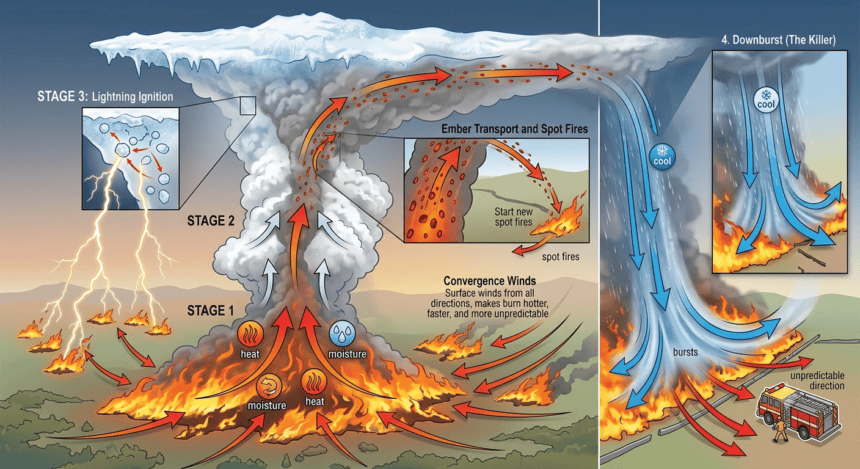
Scientists call these fire-generated thunderstorms “pyrocumulonimbus” (pyroCb). They are essentially atmospheric monsters born from heat. When a blaze intensifies, the rapid upward rush of hot air and moisture creates a massive convection column. As this column rises into the upper atmosphere, it cools and condenses, forming a towering cloud that acts like a chimney, sucking in more oxygen and fueling the flames below.
The results are chaotic. These clouds don’t just produce rain; they generate lightning far outside the main fire perimeter. This lightning strikes dry vegetation miles away, effectively sparking new fires and creating a self-sustaining cycle of destruction.
“It’s a feedback loop that defies standard firefighting tactics,” said a senior wildfire meteorologist. “You aren’t just fighting a fire on the ground anymore. You’re fighting a weather system that is actively working to expand the disaster.”
These systems also trigger erratic, high-velocity winds. As the pyroCb cloud reaches its peak, the air can collapse downward with immense force. This “downburst” slams into the fire, spraying embers in every direction and causing the blaze to jump over firebreaks, rivers, and highways that would otherwise act as natural containment lines.
The danger for ground crews is immediate. A fire that appears to be under control can suddenly shift direction or intensify tenfold in minutes. The sheer heat of a pyroCb event can melt equipment and create lethal conditions for anyone trapped in its path.
Historically, these events were rare. They were once considered “freak” occurrences limited to the most extreme forest fires. That is no longer the case. As global temperatures rise and vegetation dries out, the conditions necessary to trigger these firestorms are becoming more frequent.
Fire agencies are now being forced to adapt. Incident commanders are increasingly relying on satellite imagery to track the development of convective columns in real-time, often pulling crews back when a pyroCb signature appears on the radar.
The strategy has shifted from suppression to survival. When the fire starts making its own weather, the only winning move is to get out of the way.