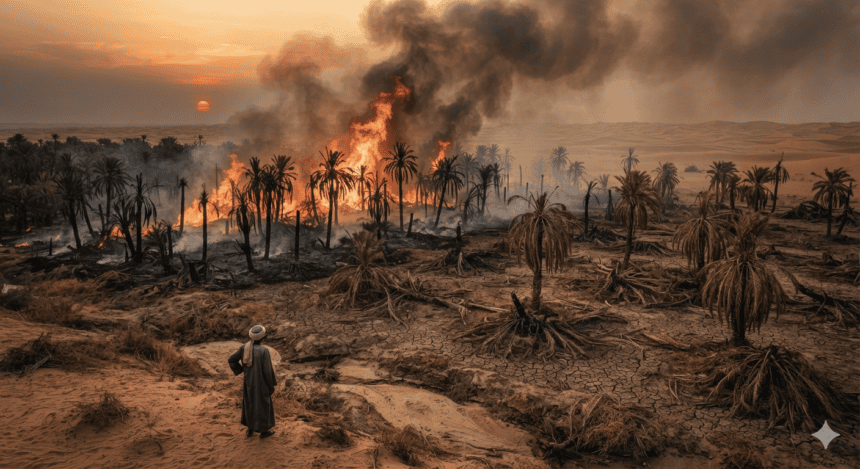
KHARTOUM — Sudan’s northern riverbanks, once lush with millions of date palms, are turning into scorched graveyards. A lethal combination of prolonged drought and intensifying wildfires is dismantling an agricultural backbone that has sustained local communities for generations.
The trees aren’t just dying; they are vanishing. In states like Northern and River Nile, farmers who once counted their wealth in fruit yields are now calculating losses in hectares of ash. The heat, which hit record levels this year, has turned the parched palm fronds into tinder. A single spark is now enough to wipe out groves that take decades to mature.
“We are losing our heritage,” said Ahmed Idris, an orchard owner near the Nile. “The water levels are dropping, the soil is turning to dust, and when the fires start, there is no equipment to stop them. We watch the trees burn.”
Water scarcity remains the primary driver of this collapse. As the Nile’s flow becomes increasingly erratic, irrigation canals have run dry, leaving the palms brittle and defenseless against the rising temperatures. The stress on the trees makes them highly flammable, turning the orchards into fire traps during the peak of the dry season.
The crisis extends beyond individual livelihoods. Sudan is one of the world’s leading producers of dates, and the destruction of these plantations threatens national food security and export revenue. With the country already reeling from broader political instability and economic ruin, the loss of this resilient crop leaves farmers with almost no safety net.
Local authorities have struggled to provide a coordinated response. Firefighting infrastructure in these remote, rural stretches is virtually non-existent, leaving villagers to fight flames with buckets of sand and limited water. Experts warn that without a massive investment in drought-resistant irrigation and fire-break management, the iconic landscape of Northern Sudan will be permanently altered within a decade.
For the farmers, the transition is stark. They are moving from a state of seasonal harvest to one of constant vigilance. Every dry, hot day is now a gamble, and for many, the cost of protection has already become higher than the value of the crop itself.