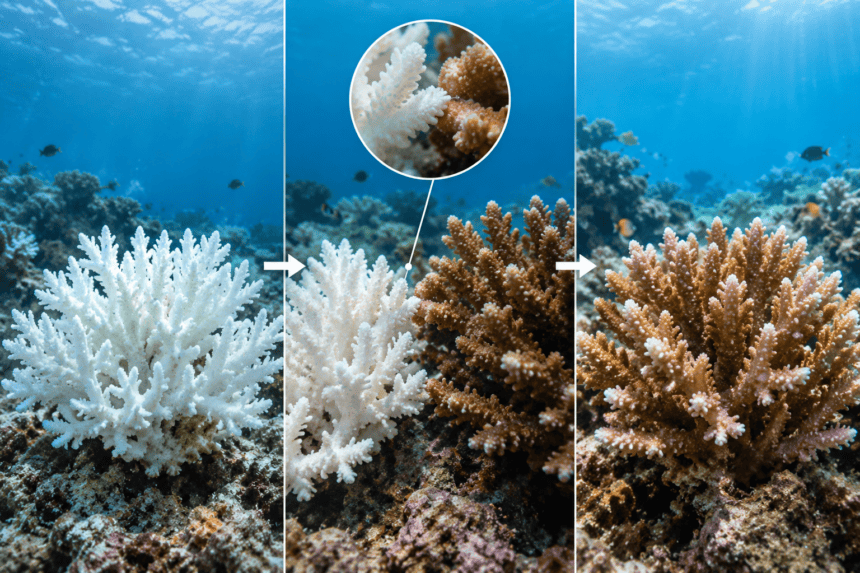
Coral reefs under heat stress have a chance at recovery through an unlikely mechanism: physical contact with healthy neighbors. A study published in *Nature Communications* reveals that bleached corals can regain their color and vitality significantly faster when they come into contact with non-bleached counterparts.
Researchers at the University of Queensland observed that the transfer of essential nutrients or biological signals occurs during these physical interactions. For years, the prevailing view held that bleached corals were largely passive victims of rising ocean temperatures. This finding shifts that perspective, suggesting that reef structures act more like a collaborative network than a collection of isolated organisms.
The study focused on *Pocillopora* corals, commonly found in the Pacific. When a bleached colony touched a healthy one, the stressed coral showed a 30% increase in recovery speed compared to those left in isolation.
“We aren’t just looking at structural support,” said Dr. Alexia Graba-Landry, lead author of the study. “There is a literal exchange happening at the tissue level that helps the weaker coral get back on its feet.”
This discovery challenges current restoration strategies. Most conservation efforts focus on planting coral fragments in grids, often spacing them out to prevent competition for space. If physical contact is a catalyst for recovery, these spacing guidelines may actually hinder the reef’s natural defense mechanisms against heatwaves.
The implications for global reef management are immediate. As marine heatwaves become more frequent, scientists are now looking at whether “clustering” corals during restoration projects could provide a survival advantage. By forcing contact, conservationists might be able to create “nursing” clusters that help weaker corals survive the initial shock of a bleaching event.
While this mechanism offers a glimmer of hope, it is not a panacea. The study confirms that if the water temperature remains too high for too long, no amount of physical contact can save the colony.
Even with this biological boost, the fundamental driver remains the same: if the oceans don’t cool, the networks will eventually fail. For now, the research provides a new tool for those trying to keep reefs alive in a warming world.