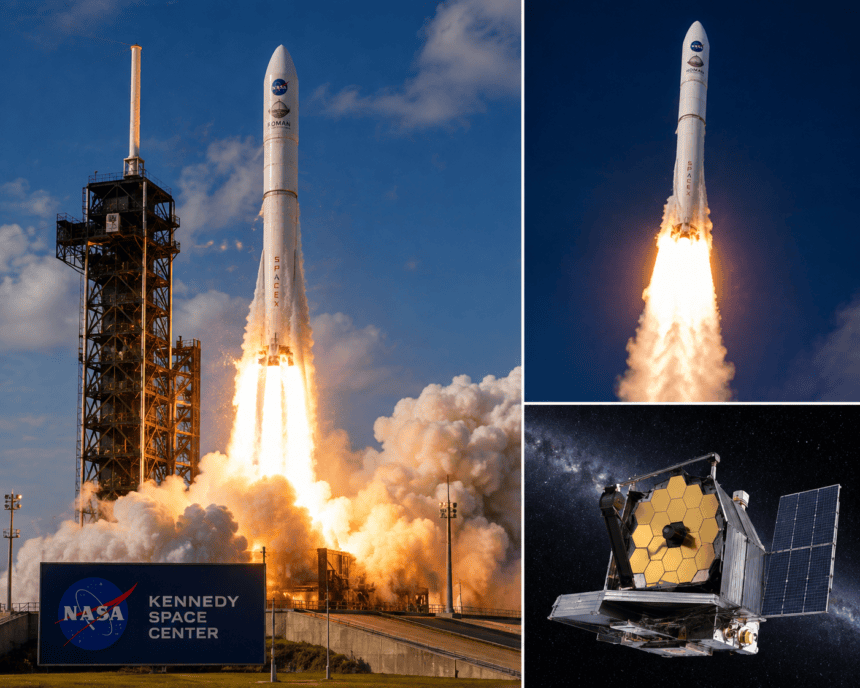
CAPE CANAVERAL, Fla. — NASA’s Nancy Grace Roman Space Telescope climbed into the Florida sky Thursday, beginning a five-year mission to peel back the layers of the dark universe. The rocket cleared the launchpad at 10:14 a.m. EST, carrying an observatory designed to see the cosmos with 100 times the infrared field of view of the Hubble Space Telescope.
The mission is built for scale. While Hubble and the James Webb Space Telescope provide surgical, high-resolution peeks at specific targets, the Roman telescope is a wide-angle camera for the heavens. It will capture sprawling snapshots of galaxies and star clusters, allowing astronomers to build a comprehensive map of how dark energy and dark matter have shaped the expansion of the universe over billions of years.
“We aren’t just looking at stars anymore; we are looking at the architecture of space itself,” said Dr. Julie McEnery, the mission’s senior project scientist. She spoke to reporters shortly after the observatory successfully deployed its solar arrays. “Roman gives us the context we’ve been missing.”
The telescope’s primary mirror, spanning 2.4 meters, is identical in size to Hubble’s. However, the technology packed behind it represents a leap forward. Its sensors can scan the sky at a speed that would take Hubble centuries to replicate. By observing billions of galaxies, the team expects to identify thousands of new exoplanets, potentially finding worlds that have remained hidden by traditional deep-space imaging.
The mission, however, faces a high-stakes deployment. In the coming weeks, the telescope must navigate its way to the second Lagrange point (L2), a million miles from Earth. It will then undergo a rigorous six-month commissioning phase to calibrate its massive instrument suite.
For the scientific community, the stakes are existential. Dark energy remains the most significant “missing” variable in modern physics, accounting for nearly 70% of the universe yet remaining entirely invisible. Roman won’t just photograph these mysteries; it will provide the statistical weight needed to confirm or challenge existing theories on cosmic acceleration.
If the hardware performs as expected, the first stream of deep-space data will reach Earth by late next year. Until then, the mission control team at Goddard Space Flight Center will manage the silent, million-mile drift of a machine that is, for now, the most advanced eye on the universe.