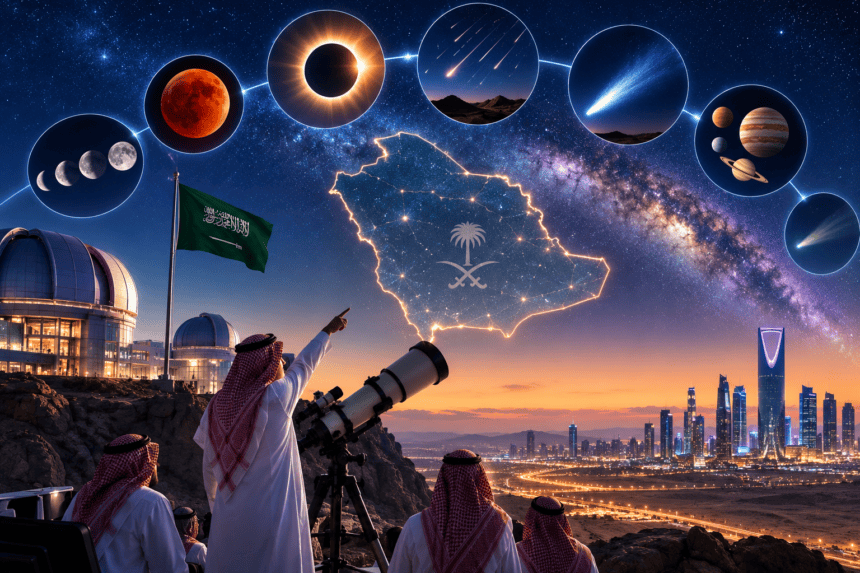
The Saudi Space Agency has released its “Celestial Events Guide,” a comprehensive calendar mapping out major astronomical phenomena visible from the Kingdom over the next six years. The initiative aims to leverage the country’s vast, unpolluted desert skies to boost both scientific interest and the burgeoning astro-tourism sector.
The guide covers a range of events, from solar and lunar eclipses to planetary oppositions and meteor showers. Officials view this as more than just a schedule; it’s a strategic push to align Saudi Arabia with global space observation trends.
“We aren’t just tracking stars,” a project lead briefed on the initiative said. “We are establishing the Kingdom as a premier destination for those who study, photograph, and experience the night sky.”
The data—compiled by local astronomers in collaboration with international observatories—identifies specific regions within the Kingdom that offer the clearest vantage points. Areas like the AlUla desert and the Rub’ al Khali are highlighted as primary hubs for observation, largely due to their low light pollution and stable atmospheric conditions.
By 2030, the agency expects these events to draw thousands of international visitors. This aligns with the broader Vision 2030 objective of diversifying the economy. Beyond the tourism angle, the agency plans to use these events to host workshops for students and amateur astronomers, hoping to foster a domestic generation of space scientists.
The guide is now accessible through the agency’s digital portal, which provides real-time updates and technical specifications for capturing these events. While the calendar is ambitious, the agency has built in flexibility; they’ve committed to issuing quarterly updates as new celestial data becomes available.
For those planning trips to the interior, the agency warns that while the events are mapped, the desert environment remains unpredictable. “The sky is clear, but the terrain demands respect,” the lead added.
With the first major alignments expected later this year, the agency is already coordinating with local municipalities to ensure infrastructure is ready for the influx of sky-watchers. The Kingdom’s shift toward the stars is no longer just a long-term goal—it’s a scheduled event.