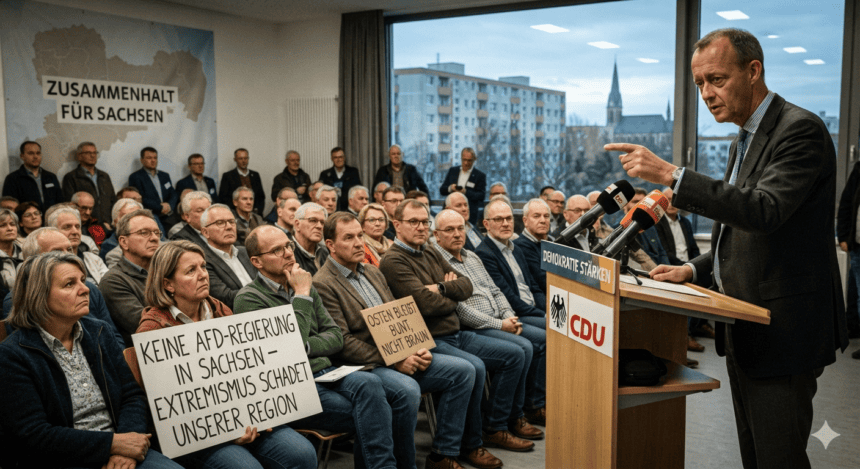
Friedrich Merz, leader of the center-right Christian Democratic Union (CDU), says a government involving the far-right Alternative for Germany (AfD) would devastate the country’s eastern states. With regional elections looming in Saxony, Thuringia, and Brandenburg, Merz is drawing a hard line against any cooperation with the party.
The stakes go beyond political rhetoric. Merz argues that an AfD-led administration would scare off international investors, paralyze local economies, and isolate the region from the rest of the federal republic. He frames the choice as one between economic stability and ideological extremism.
“If the AfD takes charge, the investment climate in the east will collapse overnight,” Merz told reporters in Berlin. He pointed to the region’s fragile industrial base, noting that companies rely heavily on global supply chains and a welcoming social environment to attract skilled labor.
Current polling shows the AfD leading in both Thuringia and Saxony. While the party has gained significant ground on issues like migration and inflation, other mainstream parties—including the CDU—have maintained a “firewall” policy, refusing to enter formal coalitions with them. Merz is under pressure from local party members to clarify how the CDU would govern if it cannot form a majority without the far-right.
Some CDU politicians in the east have privately suggested that the national party’s rigid stance ignores the reality of local voter frustration. They argue that constant warnings from Berlin sound out of touch to residents who feel left behind by federal policies.
Merz rejects this assessment. He insists that the CDU’s identity is non-negotiable. For him, the AfD isn’t just another opposition party; he views their platform as an existential threat to Germany’s democratic institutions.
Whether this strategy holds up at the ballot box remains the central question of the campaign. If the AfD secures a plurality, the CDU will face a brutal dilemma: attempt a precarious minority government, join a wide-ranging “grand coalition” with political rivals, or watch from the sidelines as the far-right dictates the agenda.
As the vote approaches, Merz is betting that voters will prioritize economic pragmatism over protest politics. If he is wrong, the political map of eastern Germany will change in ways that even the most seasoned observers struggle to predict.