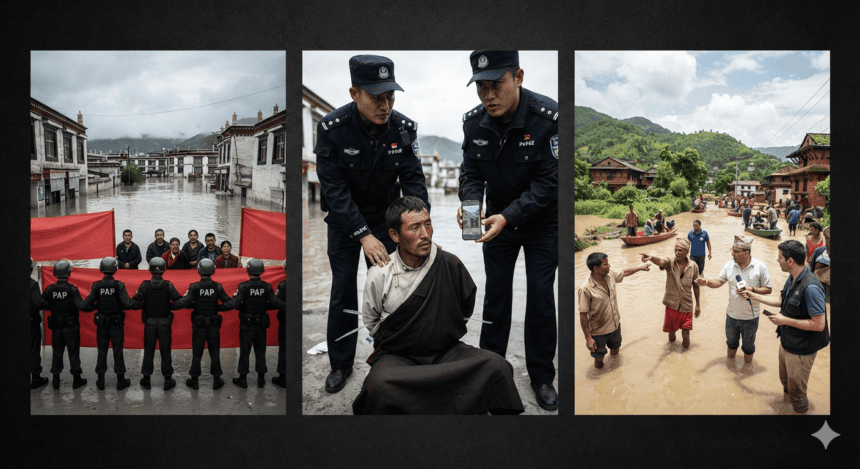
BEIJING — As record-breaking floods tore through the Yarlung Tsangpo basin last week, the Chinese state apparatus moved faster than the water. While officials in Kathmandu opened their doors to international observers and media to document the devastation across Nepal, authorities in Lhasa went dark.
The Chinese government’s response in the Tibet Autonomous Region was defined by a calculated silence. Where Nepal’s disaster management agencies provided real-time death tolls and infrastructure loss estimates, Chinese state media outlets focused on “heroic” rescue efforts by the People’s Liberation Army. Independent reporting from the region remains effectively non-existent.
Local sources report that mobile communications in flood-hit areas of Shigatse were restricted shortly after the initial surge. Those who attempted to share footage of damaged homes on WeChat or Douyin found their accounts flagged or their posts scrubbed within minutes. The narrative Beijing permits is singular: the party is in total control, and the recovery is already underway.
The contrast with Nepal highlights a stark divide in regional crisis management. In Kathmandu, the government’s transparency—while often criticized for bureaucratic slowness—allows for a clearer picture of the human cost. Families track missing relatives through public databases, and NGOs provide on-the-ground updates that occasionally contradict official government claims.
In Tibet, the reality is mediated entirely through the lens of national stability. By restricting information, Beijing avoids the political fallout that comes with admitting infrastructure failure or inadequate early-warning systems. For the residents of the Yarlung Tsangpo valley, the floods aren’t just a natural disaster; they are a test of silence.
Beijing’s refusal to allow independent assessment of the flood damage serves a specific strategic purpose. It prevents domestic and international scrutiny of environmental management in a sensitive border zone. When the water recedes, the only history of the event will be the one the state decides to keep.
As of Tuesday, the official toll in Tibet remains suspiciously static, while aid workers on the Nepal side of the border continue to uncover the scale of the destruction. For the people trapped on the wrong side of the censorship wall, the disaster is far from over—it’s just being erased.