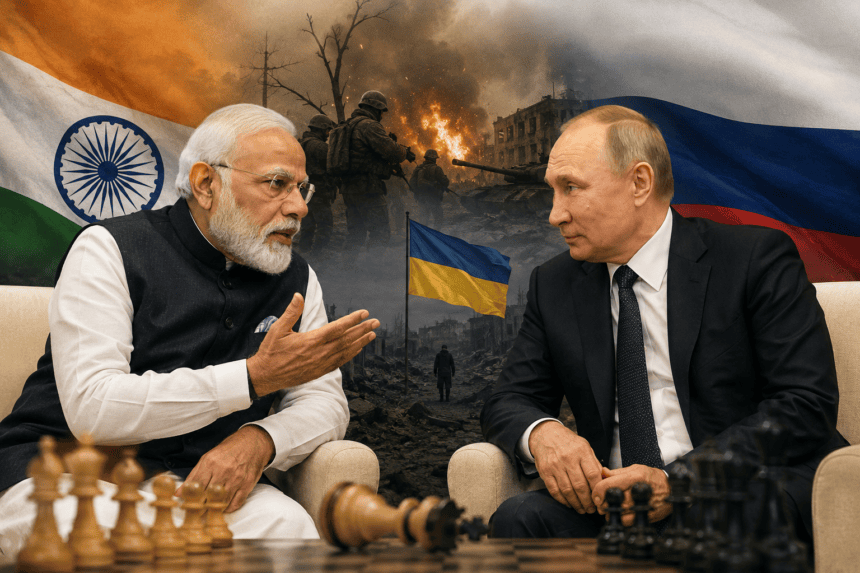
Prime Minister Narendra Modi walked into the Kremlin this week with a message that shifted the optics of India’s foreign policy: the war in Ukraine must end. Sitting across from Vladimir Putin, Modi delivered a blunt assessment, telling the Russian leader that “war does not find solutions” and that peace talks are the only viable path forward.
For New Delhi, the visit was a high-stakes balancing act. India has historically relied on Russia for military hardware and, more recently, discounted oil. Yet, by calling for an end to the hostilities, Modi signaled that India’s “strategic autonomy” is no longer just about hedging between powers — it’s about positioning itself as a credible mediator on the global stage.
The timing is telling. The meeting occurred just as NATO leaders gathered in Washington to reaffirm their commitment to Kyiv, highlighting the stark divide between Moscow and the West. By choosing to visit Moscow now, Modi isn’t just maintaining a relationship; he’s testing how much leverage he actually has with a Kremlin that has become increasingly isolated.
Putin’s reaction was scripted but telling. He thanked Modi for his efforts to find “peaceful ways” to resolve the crisis, yet he showed no sign of wavering on his objectives. The Russian war machine remains entrenched, and the Kremlin’s messaging continues to frame the conflict as an existential struggle against Western encroachment.
Western capitals are watching closely. The Biden administration has previously expressed frustration over India’s continued engagement with Russia, particularly regarding energy purchases. However, Modi’s public remarks in Moscow provide the White House with a sliver of hope: India is finally using its voice to push for a resolution rather than just staying on the sidelines.
The reality, however, is that Modi’s influence has limits. Putin is not under the kind of economic or diplomatic pressure from New Delhi that would force a retreat from the Donbas. India provides Russia with a vital economic lifeline, but it is not a policy-maker in the Kremlin.
Ultimately, Modi’s push for peace may not stop the artillery fire in Ukraine, but it has successfully recalibrated India’s image. New Delhi is no longer content to be a silent observer of the conflict. Whether this diplomatic intervention translates into real-world change remains a question of whether Putin sees any benefit in listening—or if he simply sees Modi as a useful partner who won’t demand a change in behavior.