KATHMANDU — The search for the missing in Nepal has moved from the mud-caked riverbanks to the cremation pyres, but many families are returning home with nothing but ashes of grass.
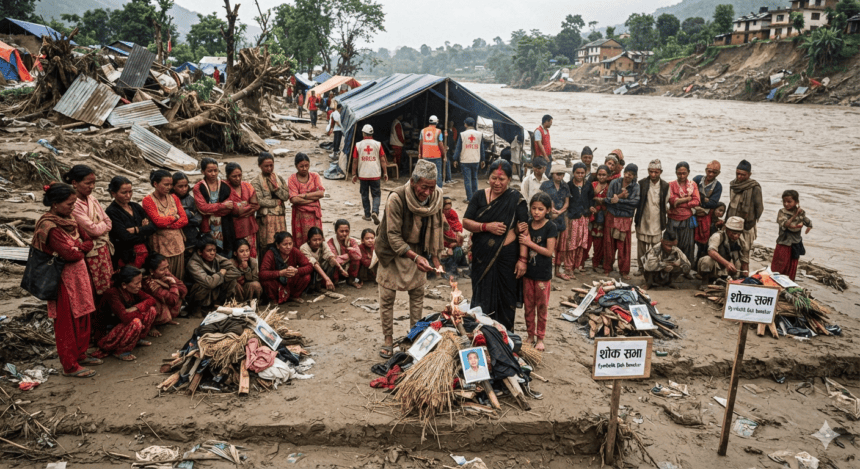
As the death toll from last week’s catastrophic monsoon floods climbs past 240, dozens remain buried under landslides or swept away by the Bagmati and Nakkhu rivers. For those whose loved ones haven’t been found, the wait for a body has become an unbearable luxury. They are turning instead to *Kush-puttal* — a centuries-old Hindu ritual where an effigy made of sacred Kush grass is cremated in place of the physical remains.
“We can’t wait for the river to give him back,” said one mourner at the Pashupatinath temple complex, eyes fixed on a small bundle of grass wrapped in white cloth. “Without the fire, his soul is stuck. We have to let him go.”
This isn’t just a matter of grief; it’s a religious deadline. In Nepali Hindu tradition, the final rites must be performed to ensure the deceased finds peace. When a body is lost to a natural disaster, the family waits a symbolic period — often three to twelve days — before accepting that the earth or the water won’t surrender its dead.
The scale of the devastation makes these symbolic funerals a grim necessity. Entire settlements along the river corridors were erased in hours. In the Kathmandu Valley, the water rose so fast that people were trapped on rooftops and inside buses buried by mud on the highways leading out of the capital.
Search teams are still digging through the debris, but the window for finding survivors closed days ago. Now, they’re mostly finding fragments of lives — a shoe, a school bag, a twisted frame of a motorbike.
The government’s response has faced sharp criticism. Rescue helicopters were delayed by weather, and many survivors spent hours clinging to trees and poles while police and army units struggled to reach them with rubber boats. Prime Minister KP Sharma Oli admitted the state’s “shortcomings” in the face of the scale of the disaster, but for those on the riverbanks, political apologies mean little.
The “So What?” of this tragedy is a long-term psychological scar. In a culture where the physical body is essential for the transition to the afterlife, the absence of a corpse leaves a void that a grass effigy can only partially fill.
“The ritual provides a legal and religious end,” says a local priest at the ghats. “But for the mother or the wife, the mind always wonders if they are still out there, buried under the silt.”
As the rains finally recede, the focus is shifting to reconstruction. But for the families of the missing, the landscape has been permanently altered. They aren’t just rebuilding houses; they are mourning shadows.
The fires at Pashupatinath will continue to burn this week. Some will smell of burning flesh, others only of dry grass. For the families of Nepal’s missing, both signify the same final, hollow goodbye.