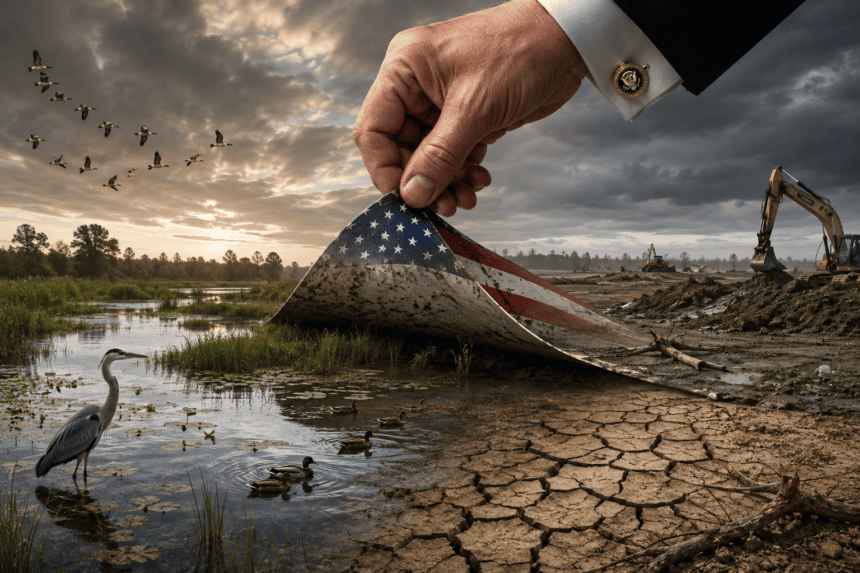
The Trump administration is moving to strip federal safeguards from millions of acres of wetlands and intermittent streams, a shift that effectively reverses decades of environmental policy. The Environmental Protection Agency’s new guidance directs regional offices to stop asserting jurisdiction over water bodies that lack a continuous surface connection to larger, protected waterways.
This decision hits the agricultural and development sectors hardest, as it removes the need for federal permits to fill in or build over vast stretches of land once considered protected under the Clean Water Act. For farmers and developers, the move signals a drastic reduction in regulatory hurdles. For environmental groups, it marks the end of a critical barrier against pollution and flood risks.
“We are providing clarity and regulatory certainty,” an EPA spokesperson said Tuesday, noting that the agency aims to return authority to state-level regulators. Yet, agency staff familiar with the internal directive say it leaves a massive vacuum in oversight, as many states lack the staff or the legal framework to manage the newly unprotected waters.
The move relies heavily on a narrow interpretation of recent Supreme Court rulings, specifically targeting waters that do not maintain a direct, visible link to permanent rivers or lakes. By focusing solely on surface flow, the administration is ignoring the complex subterranean networks that move water and contaminants between isolated wetlands and the broader watershed.
Critics point to the potential for widespread ecological damage. Wetlands act as natural sponges, absorbing floodwaters and filtering runoff before it reaches public drinking supplies. Without federal oversight, developers can now pave over these areas without mitigation requirements—a process that historically involved creating or restoring wetlands elsewhere to offset the loss.
Agriculture lobbyists have pushed for this change since the early days of the administration, arguing that federal jurisdiction had grown too broad, often ensnaring small drainage ditches on private property. The American Farm Bureau Federation praised the move as a long-overdue correction, claiming it restores the balance between private property rights and environmental stewardship.
Conservationists are already preparing for litigation. They argue that the policy is not a return to state control, but an abdication of federal responsibility that will inevitably lead to degraded water quality downstream. With the legal challenges looming, the practical impact on the ground remains in limbo, but the administration’s intent is clear: federal oversight of the nation’s smallest waters is effectively coming to an end.