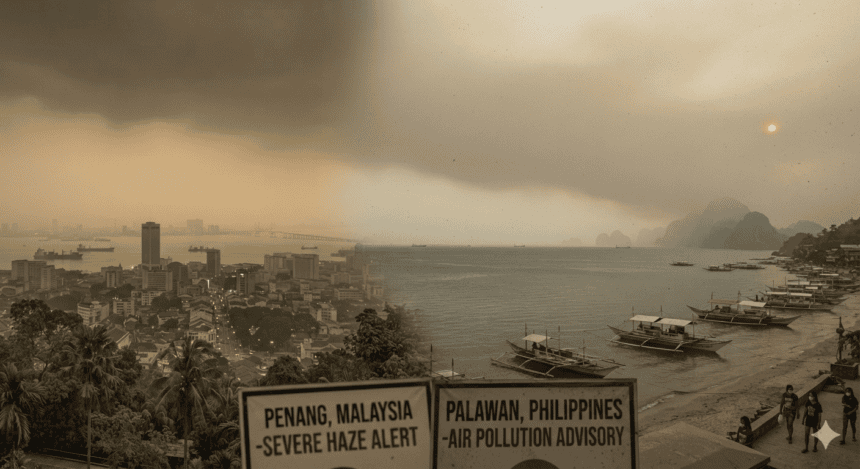
JAKARTA, September 5, 2026: Toxic haze from widespread forest and land fires in Indonesia has spread across parts of Southeast Asia, affecting Malaysia, Brunei, Singapore and the Philippines and raising concerns over public health and the environment.
The fires, which have intensified during Indonesia’s severe dry season, have sent smoke hundreds of miles across the region. Winds have carried the haze from fire-hit areas of Sumatra and Kalimantan into neighbouring countries, where air-quality levels have deteriorated sharply.
Malaysia Faces Hazardous Air Quality
Malaysia’s Sarawak state has been among the worst-affected areas. On September 4, authorities declared an emergency in the Serian district after the air pollution index reached 519, exceeding the country’s emergency threshold of 500.
The emergency applies to an area within a 20-kilometre radius of Serian. Schools have been closed in some parts of Sarawak, while authorities have also begun cloud-seeding operations to try to improve conditions.
Kuching, Sarawak’s capital, has also recorded hazardous air quality. The worsening conditions have disrupted outdoor activities and raised concerns about respiratory problems among residents.
Haze Reaches the Philippines
The smoke has travelled beyond Malaysia and reached the Philippines. Parts of Metro Manila and other areas have experienced unhealthy air as fine particles from the Indonesian fires spread across the region.
A recent assessment found that air pollution in Metro Manila reached acutely unhealthy levels between August 30 and September 2, with pollution levels exceeding the World Health Organization’s recommended guideline by more than four times.
Authorities have issued health advisories urging people, particularly children, older adults and those with respiratory conditions, to reduce prolonged outdoor exposure when air quality deteriorates.
Indonesia’s Fire Crisis
Indonesia itself remains at the centre of the crisis. Forestry data indicates that more than 202,000 hectares had been burned nationwide between January and June, while almost 95,000 hectares were affected by fires in July alone. There is not yet official nationwide data for August.
West Kalimantan has been particularly badly affected. In some areas, visibility has fallen dramatically as thick smoke covers communities, while air pollution has reached hazardous levels.
The fires have also affected education. Around 1.4 million students in six Indonesian provinces were moved to online learning because of dangerous air quality.
El Niño and Human Activity
Indonesia’s Meteorology, Climatology and Geophysical Agency has linked the severe dryness to a strong El Niño, which has created conditions favourable for the spread of fires.
However, officials and environmental experts say weather alone does not explain the crisis. Human activities, including land clearing and the use of fire to prepare land for plantations, are also believed to be major contributors.
Indonesian authorities have arrested people suspected of deliberately starting fires and are investigating whether companies were involved in illegal land clearing.
Threat to Health and Wildlife
The haze is creating a significant public-health concern across Indonesia and neighbouring countries. Fine particles in wildfire smoke can penetrate deep into the respiratory system and worsen existing breathing and cardiovascular problems.
Wildlife is also suffering. Indonesia’s forests provide critical habitat for endangered orangutans, and several animals have already required rescue and medical treatment after being affected by fire and heavy smoke.
Environmental groups warn that the burning of peatlands is particularly dangerous because peat can continue smouldering underground and release large quantities of carbon emissions.
Regional Response
Indonesia has deployed tens of thousands of personnel to fight the fires, supported by ground operations, water bombing and weather-modification efforts. Authorities are focusing heavily on fire-hit areas in Sumatra and Kalimantan.
The ASEAN region has also activated its highest transboundary haze alert for parts of southern Southeast Asia as smoke continues to cross national borders.
With September expected to remain a critical month for the fire season, authorities across the region are closely monitoring air quality and preparing additional measures to protect communities.