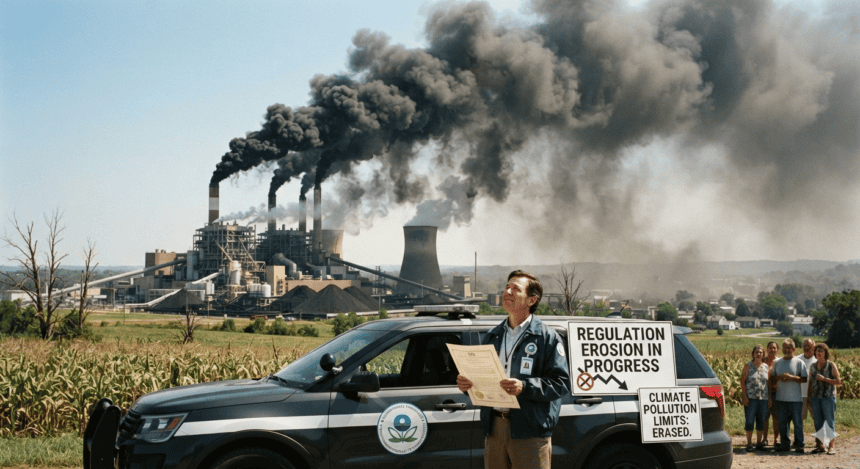
The Environmental Protection Agency is moving to erase federal limits on climate pollution from the nation’s power plants, a decision that effectively ends the government’s most ambitious attempt to curb greenhouse gas emissions.
The move targets the Clean Power Plan, a regulation designed to shift the U.S. energy grid away from coal and toward wind, solar, and natural gas. By removing these mandates, the EPA is pivoting toward a “state-first” approach. This allows individual states to decide how—or if—they want to regulate the carbon dioxide pouring out of their coal-fired stacks.
This isn’t just a technicality in environmental law. It’s a fundamental shift in how the U.S. manages its contribution to global warming. Without federal caps, there’s no longer a uniform requirement for utilities to retire aging, high-emission coal plants. Instead, the EPA’s new direction focuses on modest efficiency “upgrades” that plants can make on-site—changes that experts say will do little to actually lower the country’s total carbon footprint.
For the coal industry, the rollback is a hard-won victory. Industry leaders have long argued that federal mandates were an overreach that threatened the reliability of the power grid and drove up costs for consumers. “We’re returning to the rule of law,” a senior EPA official said during the briefing, asserting that the previous administration lacked the authority to force a wholesale shift in the energy market.
Environmentalists and health advocates see it differently. They point to the agency’s own previous data, which suggested that weakening these rules could lead to an additional 1,400 premature deaths annually due to increased levels of soot and nitrogen oxide.
“The EPA is effectively abdicated its responsibility to protect the public,” said David Doniger, a senior attorney with the Natural Resources Defense Council. He noted that the agency is legally required to regulate carbon under the Clean Air Act—a duty he argues this new policy ignores.
The impact will be felt most in states that still rely heavily on coal. While some states like California and New York have their own strict climate laws, others have no such protections. This creates a patchwork of regulations where a plant in one state can pollute at levels that would be illegal just across the border.
Legal challenges are already lining up. A coalition of 20 states and several environmental groups plan to sue the agency, likely tied to the argument that the EPA cannot ignore the scientific consensus on climate change. This battle won’t end at the agency’s headquarters; it’s headed straight for the federal courts.