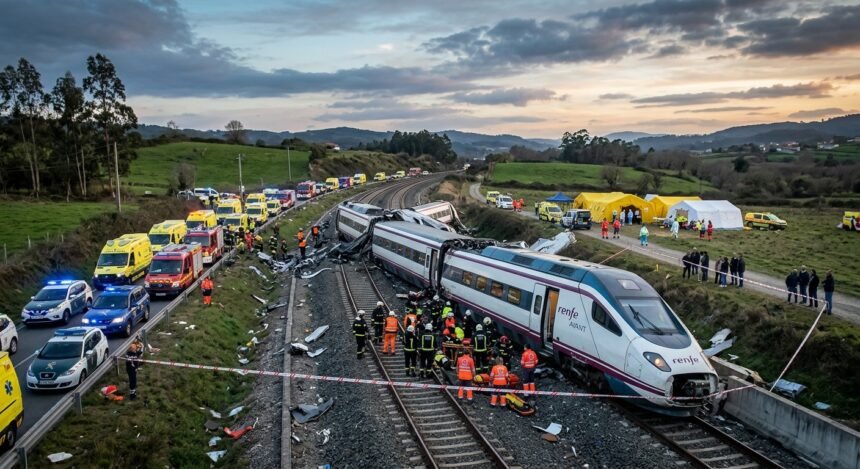
SANTIAGO DE COMPOSTELA — A high-speed train derailed on the outskirts of this northwestern Spanish city Wednesday evening, killing at least 68 people and leaving scores more trapped in the wreckage.
The train, carrying over 200 passengers, was traveling from Madrid to Ferrol when all 13 carriages jumped the tracks on a sharp curve. Emergency responders are currently working through the night to extract survivors from the mangled metal, with officials warning the death toll will likely climb as search efforts progress.
“The scene is Dante-esque,” said a local emergency worker, describing the carnage as carriages piled onto one another, some catching fire immediately upon impact.
Regional government officials have confirmed the fatalities, but identifying the victims remains a slow, agonizing process. Hospitals in Santiago have issued urgent appeals for blood donations, as local residents line up outside clinics to help those pulled from the debris.
Preliminary reports point to excessive speed as a potential cause. The train was reportedly traveling on a stretch of track where the speed limit is 80 kilometers per hour, though local media suggests the train may have been moving significantly faster. State railway operator Renfe has not confirmed these details, saying only that an investigation into the mechanical and human factors is underway.
This disaster marks one of Spain’s deadliest rail accidents in decades. The impact was so severe that some carriages were thrown several meters from the track, landing near residential buildings. Residents described hearing a massive explosion followed by screams, prompting many to rush toward the tracks with blankets and water before official help arrived.
Prime Minister Mariano Rajoy is expected to arrive at the site Thursday morning. For now, the focus remains entirely on the wreckage. With dozens of passengers still unaccounted for and many hospitalized in critical condition, the city remains in a state of shock, waiting for a final count that authorities fear will be far higher than current estimates.