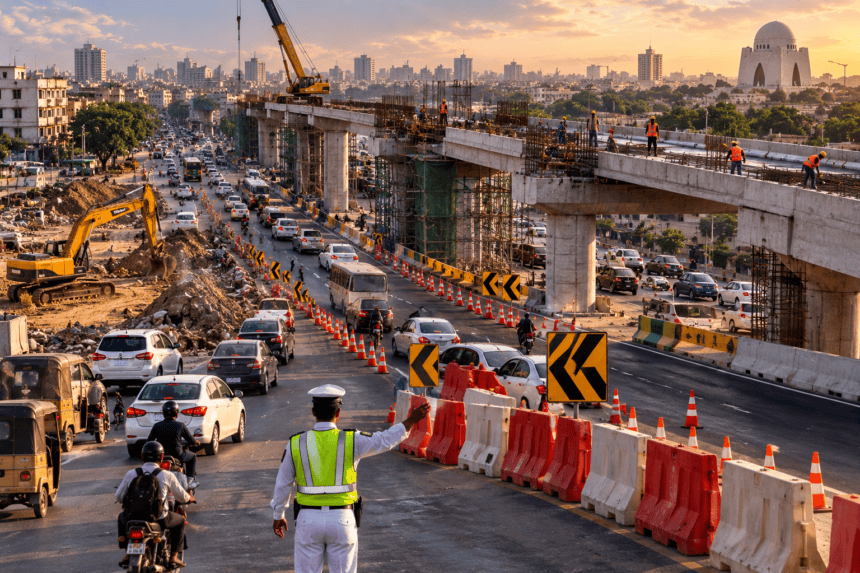
Karachi’s commuters face months of gridlock starting Monday as the city’s municipal authorities initiate major construction work on the Nishtar Road and Garden Road flyovers. The project, aimed at easing long-term congestion, will effectively cut off two of the city’s most critical arteries.
Traffic police finalized the diversion plan late Sunday, shifting heavy and light vehicle flow to alternative routes through Soldier Bazaar and parts of the Saddar corridor. Officials acknowledged the construction will likely cause severe delays during morning and evening peak hours.
“We know it’s going to be a rough ride,” a senior traffic official said. “But the structural integrity of these intersections couldn’t wait another year.”
The project, overseen by the Karachi Infrastructure Development Company, involves the complete closure of the Nishtar Road flyover for structural repairs and a partial demolition of the Garden Road connector to facilitate a new lane expansion. Officials expect the work to continue for at least three months, weather permitting.
Residents in the surrounding neighborhoods are already bracing for the spillover. With main roads blocked, local streets—many already struggling with broken pavement and sewage issues—will likely see a surge in heavy traffic.
For the thousands of traders operating in the nearby markets, the timing is particularly difficult. Access to loading zones will be restricted, and delivery schedules will need to be pushed to late-night hours to avoid the inevitable daytime bottlenecks.
Commuters are being urged to use the Lyari Expressway or Sharea Faisal as alternatives whenever possible. However, with those routes already operating at near-capacity, the city’s traffic management system faces its most significant test of the year.
While the city administration promises a smoother flow once the flyovers are upgraded, the immediate reality for Karachiites is a long, slow crawl through the city center. Whether the construction schedule holds—or slips as projects in the city often do—remains the primary concern for daily travelers.