A 5.7-magnitude earthquake struck off Japan’s coast Tuesday morning, sending tremors through the Izu Islands and triggering a brief tsunami advisory for remote coastal areas.
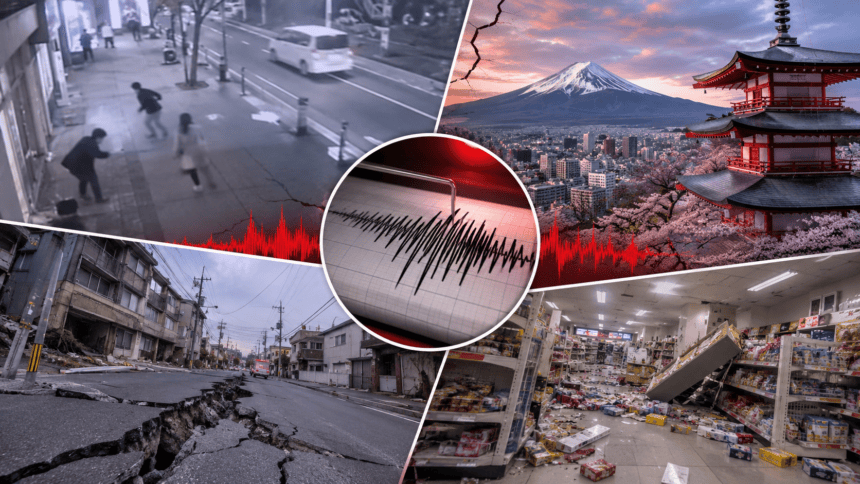
The quake hit at 8:14 a.m. local time near Torishima island at a shallow depth of roughly 10 kilometers. While the epicenter was located in the Pacific Ocean, the energy released was enough to shake infrastructure across the island chain. CCTV footage from several locations captured the moment the tremors reached land—showing street signs vibrating violently, parked vehicles rocking, and birds scattering from power lines.
The Japan Meteorological Agency (JMA) immediately issued a tsunami advisory for the Izu and Ogasawara islands, warning that waves could reach heights of one meter. Residents were told to stay away from the shoreline and river mouths.
The actual impact remained relatively localized. A 50-centimeter wave was recorded at Yaene on Hachijo Island about 40 minutes after the quake. Smaller swells followed at other points along the coast, though no significant flooding was reported.
Local authorities confirmed there were no immediate reports of major injuries or structural damage. “We felt a sustained shaking for several seconds,” one resident on Hachijo Island told local media. “It wasn’t enough to knock things off the shelves, but the tsunami warning is what always makes people move to higher ground.”
Japan sits on the “Ring of Fire,” an arc of intense seismic activity where several tectonic plates meet. This specific region near Torishima is a known hotspot for submarine volcanic activity and frequent mid-sized tremors.
The JMA lifted the tsunami advisory roughly two hours after the initial shake once sea-level fluctuations subsided. While the immediate threat has passed, officials warned that aftershocks could occur over the next few days—a standard but necessary precaution in one of the world’s most earthquake-prone nations.