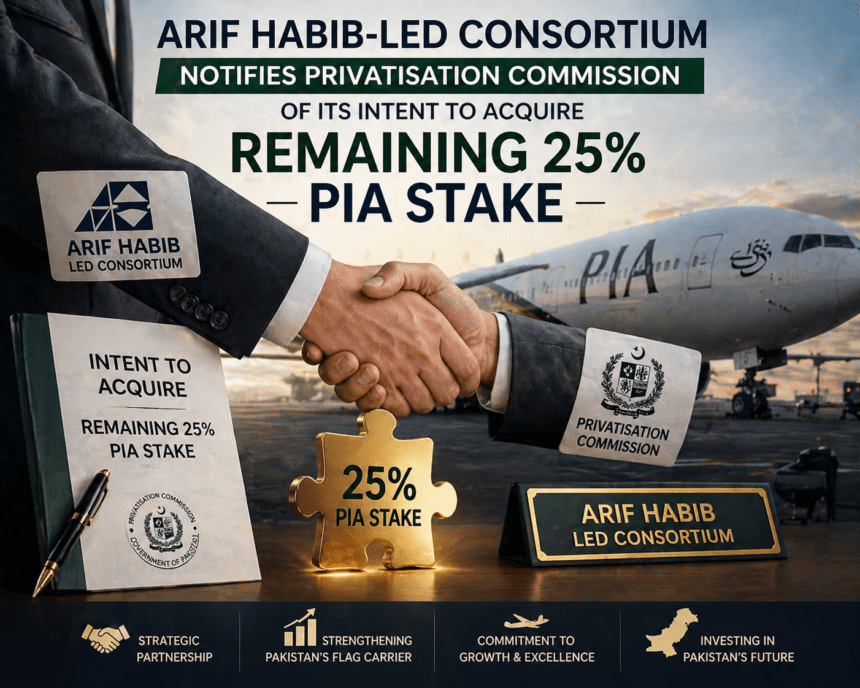
The consortium led by Arif Habib has formally told Pakistan’s Privatisation Commission that it wants to acquire the government’s remaining 25% stake in Pakistan International Airlines, a move that could turn its earlier majority purchase into full ownership. Current reports say the group has already submitted a standby letter of credit and a bank guarantee, signaling that the offer is more than a tentative expression of interest and that it intends to move the process forward within the required timeline.
The development comes only months after the same consortium won the bid for 75% of PIA with an offer of Rs135 billion in a closely watched privatisation auction. That sale was seen as one of Pakistan’s most significant state divestments in years, both because of PIA’s symbolic weight and because the airline had long been a financial burden on the state.
The remaining quarter stake has been widely valued at around Rs45 billion, based on earlier reporting tied to the financial close of the transaction. Officials had already indicated that the consortium had a limited window to decide whether it would also purchase the final government-held shareholding, and this latest notification appears to show the buyers are willing to go all the way rather than stop at managerial control.
That matters for more than ownership optics. A full buyout would give the consortium a freer hand in restructuring the airline, reworking management, and taking long-term decisions on routes, staffing and fleet strategy without the complications that often come with a residual state stake. For the government, it would also strengthen the narrative that the PIA privatisation is not just a partial transfer, but a near-complete exit from one of its most troubled commercial entities. This is an inference based on the ownership structure and prior privatisation context.
PIA’s sale has been closely tied to Pakistan’s broader economic reform drive. International reporting around the December auction linked the transaction to pressure for restructuring state-owned enterprises and reducing the fiscal drag created by repeated public-sector losses. The airline, once a regional heavyweight, had spent years battling debt, governance problems and operational decline before the government pushed through the privatisation process.
The immediate question now is procedural: whether the Privatisation Commission accepts the notice and how quickly the follow-on transaction is finalized. But politically and commercially, the signal is already clear. The Arif Habib-led group is not just taking control of PIA — it appears ready to take all of it.