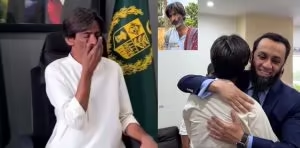
Federal Information Minister Attaullah Tarar met Azhar Memon, a young man from Khairpur, Sindh, after Memon’s story spread widely online, and told him he would be helped in finding a job. According to reports published on April 29, 2026, Memon is an MBA graduate from the University of Karachi and had drawn public attention because, despite his education, he was still unemployed and facing financial hardship.
The meeting quickly turned into a human-interest moment that cut through Pakistan’s usual political noise. Tarar said he invited Memon to Islamabad after seeing the viral material about him, and promised to support “appropriate employment arrangements,” according to the reporting now circulating in Pakistani media. Coverage described the encounter as emotional, with Tarar acknowledging the frustration and pain behind Memon’s situation.
What seems to have made the case resonate is its familiarity. Here was a highly educated graduate, reportedly confident, articulate, and degree-holding, yet still unable to secure stable work. That gap between qualification and opportunity is what pushed the story beyond a simple meeting and into a broader conversation about youth unemployment and merit in Pakistan. While the currently available reports focus mainly on the minister’s gesture rather than a formal policy response, the public reaction suggests the case struck a nerve.
Tarar is currently serving as Pakistan’s federal minister for information and broadcasting, according to the Ministry of Information and Broadcasting. That matters because the meeting was not framed as a private act of charity alone; it was presented as an intervention by a sitting cabinet minister responding to a citizen whose circumstances had become publicly visible.
For now, the reporting stops at the promise of support. There is not yet a publicly available official statement, in the sources I found, detailing what job will be offered, in which department or sector, or on what timeline. So the story, at this stage, is less about a confirmed appointment and more about a political assurance made in response to a viral appeal from an unemployed graduate in Sindh.
That leaves the next development pretty clear: whether the pledge turns into a concrete placement. Until then, Azhar Memon’s case stands as both a hopeful headline and an uncomfortable reminder that in Pakistan, even an MBA can still be waiting for a door to open.