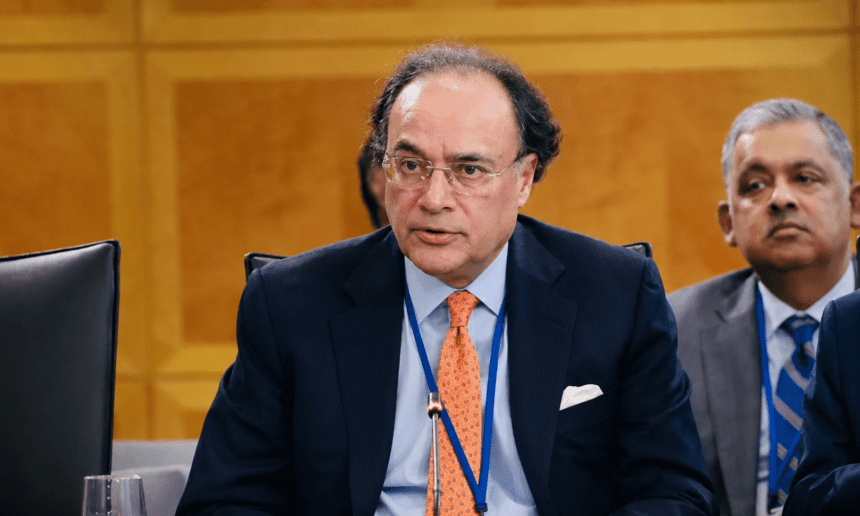
ISLAMABAD, March 10 — Finance Minister Muhammad Aurangzeb has renewed Pakistan’s push to give domestic capital markets a much larger role in financing the economy, arguing that banks alone cannot keep carrying the load if the country wants durable, investment-led growth. Chairing a meeting of the Capital Market Development Council, Aurangzeb said the immediate focus is on strengthening the corporate debt market and widening the use of market-based financing for businesses.
The message was fairly direct: Pakistan needs a more balanced financial system, one where capital markets work alongside banks rather than sit on the margins. Officials reviewed reforms meant to make it easier for companies to raise long-term funding, while also drawing more domestic savings into formal investment channels. In plain terms, the government wants local money to do more of the heavy lifting.
Aurangzeb’s remarks come at a time when policymakers are trying to deepen a market that has long been overshadowed by bank lending. At the March 10 meeting, he asked regulators to keep pushing on practical fixes: removing issuance bottlenecks, lowering intermediation costs, improving regulatory processes, strengthening market infrastructure and boosting liquidity in the secondary market for corporate debt instruments. He also told the Securities and Exchange Commission of Pakistan to step up outreach so corporates, investors and financial institutions actually understand the reforms already underway.
That may sound technical, but it matters. Pakistan’s corporate debt market has remained shallow for years, which leaves many firms dependent on bank credit, often shorter-term and more expensive than what a functioning bond market can offer. The Asian Development Bank, which has backed Pakistan’s capital-market reform programs, has argued that stronger capital markets are needed to mobilize savings more efficiently, support private investment and create a more competitive financial system. It has also noted Pakistan’s domestic savings rate has trailed regional peers, a weakness that makes long-term development harder to finance from within.
This latest push is not an isolated move. In late January, Aurangzeb met the new SECP leadership and laid out a broader agenda: deepen capital markets, diversify financing sources for both the public and private sectors, modernize infrastructure, and improve investor confidence through more efficient regulation and coordinated policy action. That meeting signaled that the finance ministry wants reform to move on several tracks at once, not just through one-off announcements.
There is, of course, a bigger macroeconomic story in the background. Pakistan is trying to rebuild confidence after a long period of external financing stress, high inflation and tight financial conditions. Aurangzeb said in April that the country is preparing to re-enter international capital markets after roughly four years, while also pursuing a diversified capital-markets strategy that includes instruments such as Eurobonds and a Panda bond. Read together, the message is pretty clear: Islamabad wants stronger domestic markets at home even as it cautiously reopens external funding channels abroad.
That dual-track strategy could prove important. A deeper domestic market gives the government and private companies more room to raise long-term funds in rupees, reducing some dependence on bank balance sheets and, over time, possibly easing pressure on foreign borrowing. It also broadens the investor base, pulling in insurers, pension funds, asset managers and, eventually, more retail investors. Those were among the priorities highlighted in the January discussions between the finance ministry and SECP leadership.
Still, the hard part begins after the speeches. Pakistan has announced capital-market reforms before, but progress has often been slowed by thin liquidity, limited investor participation, cumbersome issuance processes and weak depth in corporate debt. Officials now appear to be trying a more focused approach, dealing with market plumbing first and hoping that confidence follows. Whether that works will depend less on the rhetoric and more on whether companies actually start issuing more debt, investors show up, and secondary-market trading begins to look alive rather than symbolic.
For now, Aurangzeb’s pitch is simple enough: Pakistan cannot finance its growth ambitions through banks alone. If the reform effort holds, domestic capital markets may finally start moving from a supporting role to something closer to center stage.