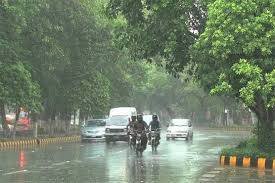
A massive hailstorm followed by hours of torrential rain turned Lahore’s main arteries into canals Tuesday, leaving low-lying neighborhoods submerged and the city’s power grid in shambles. The sudden downpour, which began in the afternoon, caught commuters by surprise and brought the provincial capital to a virtual standstill. It wasn’t just the water that caused chaos.
The hail some of it the size of golf balls shattered windshields and stripped trees bare across Gulberg, Model Town, and the Mall Road.
Visibility dropped to near zero during the peak of the storm, forcing drivers to abandon their vehicles on the hard shoulder of the Canal Road as the water level rose rapidly. By 5:00 PM, the Water and Sanitation Agency (WASA) reported over 60mm of rain in parts of the city.
Lakshmi Chowk, the traditional barometer for Lahore’s drainage struggles, was once again under two feet of water. Despite the deployment of heavy machinery, the sheer volume of water overwhelmed the city’s aging sewage system.
The human cost of the storm began to emerge as evening fell. In the Walled City and areas like Misri Shah, residents were seen franticly bailing water out of their homes with buckets. “The drain outside hasn’t been cleaned in months,” said Arshad Ali, a shopkeeper in Tajpura whose inventory was ruined by the flash flood.
“Every time it rains like this, we lose thousands. The government talks about ‘Smart Cities,’ but we can’t even handle two hours of rain.
” The power situation is equally grim. LESCO officials confirmed that over 180 feeders tripped or were shut down as a “precautionary measure” once the hailstorm intensified. Large swaths of the city, including Johar Town and Iqbal Town, remain in darkness.
Repair crews are reportedly on standby, but work can’t start until the rain stops and the standing water recedes from the transformers. While the Meteorological Department predicts the spell will continue for another 24 hours, the immediate focus remains on drainage.
WASA’s Managing Director was seen on-site at several choking points, claiming every mobile pump in the city is now operational.
Whether those pumps can keep up is a different matter. If the rain persists through the night, the “low-lying areas” won’t just be inundated they’ll be cut off entirely. “We’re doing what we can,” one drainage worker said while clearing a blocked grate near Shimla Pahari, his uniform soaked through. “But you can’t fight this much water with just hope.”