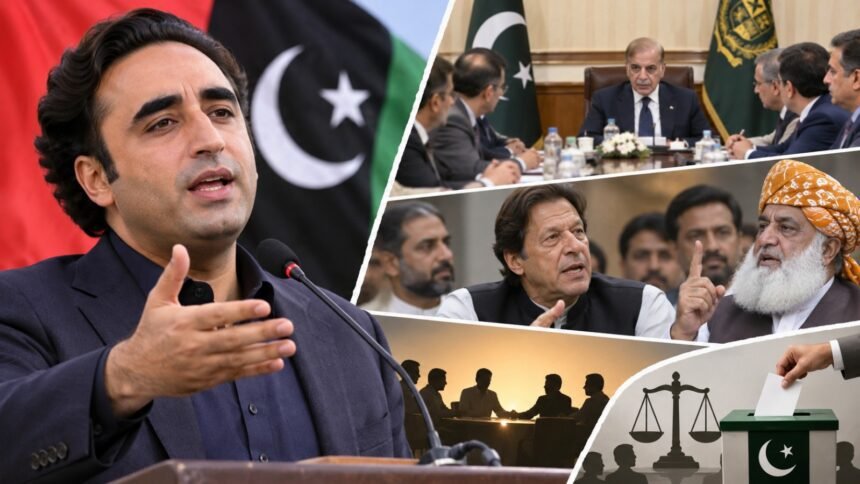
Pakistan Peoples Party (PPP) Chairman Bilawal Bhutto-Zardari has urged the federal government to stop political confrontations and engage all political, social and provincial stakeholders to address the country’s growing challenges.
Speaking at the foundation stone-laying ceremony of a 600-bed hospital in Larkana on Friday, Bilawal said the government should focus on public issues instead of continuing disputes with political opponents.
“I advise the federal government that this is the time to engage with political, social and provincial stakeholders rather than fighting everyone,” he said.
The PPP chairman warned that continued political conflicts with the Pakistan Tehreek-e-Insaf (PTI), Jamiat Ulema-e-Islam-Fazl chief Maulana Fazlur Rehman and other groups could divert attention from important national issues, including terrorism and economic difficulties.
Bilawal also expressed concern over the economic consequences of the US-Israeli war on Iran, saying its impact was being felt by ordinary people across the world. He warned that the financial burden could continue even after the conflict ended.
He stressed that the federal government’s priority should be to provide relief to people struggling with rising costs and economic hardships.
Regarding political dialogue, Bilawal encouraged the government and opposition parties to participate in the proposed electoral reforms committee to address complaints of election rigging and strengthen the democratic system.
He also invited PTI to resume negotiations with the government, saying political dialogue was necessary to resolve differences and improve national stability.
On the issue of Khyber Pakhtunkhwa, Bilawal said that if the federal government and PTI reached an agreement on a joint strategy against terrorism, he would be the first to call for ending governor’s rule in the province.
He maintained that democratically elected governments were generally better positioned to handle national challenges, while stressing that terrorism remained a serious concern.
Bilawal concluded by urging all political forces to set aside their differences and work together, saying that public welfare, economic stability and national security should remain the country’s main priorities.