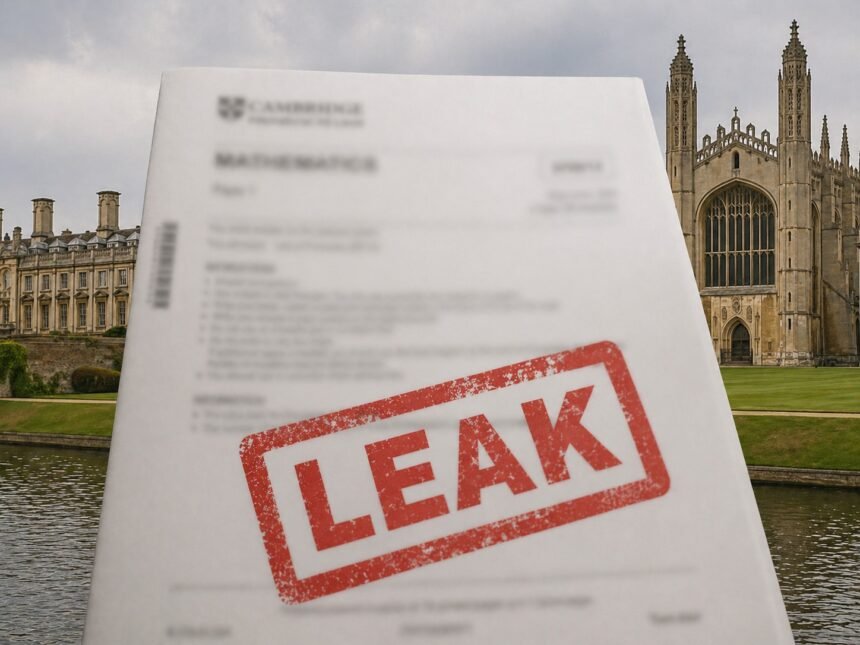
Cambridge International says it is investigating reports that an AS Level Mathematics Paper 1 (Pure Mathematics 1) was leaked online ahead of the June 2026 exam, after claims spread on social media that both solved and unsolved versions of the paper had circulated before candidates entered the exam hall. Local reports from Pakistan say the allegations triggered concern among students, especially in Karachi, where exam integrity has already been under scrutiny after earlier leak controversies.
At this stage, the key point is this: Cambridge has publicly moved to investigate, but I could not find a fresh official Cambridge statement, dated April 2026, saying the board has already conclusively confirmed this specific 2026 Mathematics leak. What is available in current reporting is that Cambridge has acknowledged the allegations and opened a formal probe. That distinction matters, especially for students and families trying to understand whether this is an allegation, a confirmed breach, or something in between.
The exam at the center of the controversy is reported to be Cambridge International AS & A Level Mathematics (9709), Paper 1, commonly known as Pure Mathematics 1. Cambridge’s own qualification pages confirm that Mathematics 9709 remains part of the 2026 series, and the June 2026 timetable is already in place for the session.
The latest uproar has landed in a country where Cambridge exam security is no longer just a one-off issue. In a formal media statement issued on June 18, 2025, Cambridge said it had concluded an investigation into allegations from the June 2025 exam series and found partial leaks in three papers. One of those was AS & A Level Mathematics Paper 12, where Cambridge said one question had been shared before the exam. It also found compromised content in Mathematics Paper 42 and Computer Science Paper 22. Cambridge said there was no evidence that full papers had been accessed in advance, and announced a remedy that awarded full marks for the affected questions while marking the rest of the papers as normal.
That 2025 finding has shaped the way students are reading the current 2026 allegation. There is now a clear pattern of distrust around exam security, particularly in Pakistan, where parliamentarians and local media have previously pressed Cambridge for answers over leak claims and their impact on students competing for university places. Reports at the time said lawmakers were shown evidence linked to multiple papers and questioned whether enough had been done to protect candidates who sat exams fairly.
For students, the anxiety is immediate and personal. A leaked paper, even a partial one, can distort grade boundaries, confidence, and the basic sense that the exam hall is a level playing field. Cambridge’s published regulations stress that centres must follow strict security rules because candidates worldwide are meant to receive the same exam experience and be treated equally and fairly. That promise is now being tested again.
There is another wrinkle here. Some third-party sites now claim Cambridge has already cancelled the leaked AS Mathematics paper and revised grading plans. I was not able to verify that through an official Cambridge source in the material currently available. So, for now, the most defensible position is that Cambridge is investigating the reported 2026 leak, while any claim of cancellation or final grading action should be treated cautiously unless and until the exam board publishes it itself.
What happens next will matter enormously. If Cambridge confirms a breach, it will have to decide whether the issue involved a full paper or selected questions, whether the spread was limited or widespread, and what remedy would be fair to candidates who took the exam honestly. Its 2025 response offers one precedent, but whether the board follows the same route this time will depend on what its investigators find. Until then, students are left in a familiar and frustrating limbo: waiting for clarity, and hoping the system proves fairer than the rumours around it.