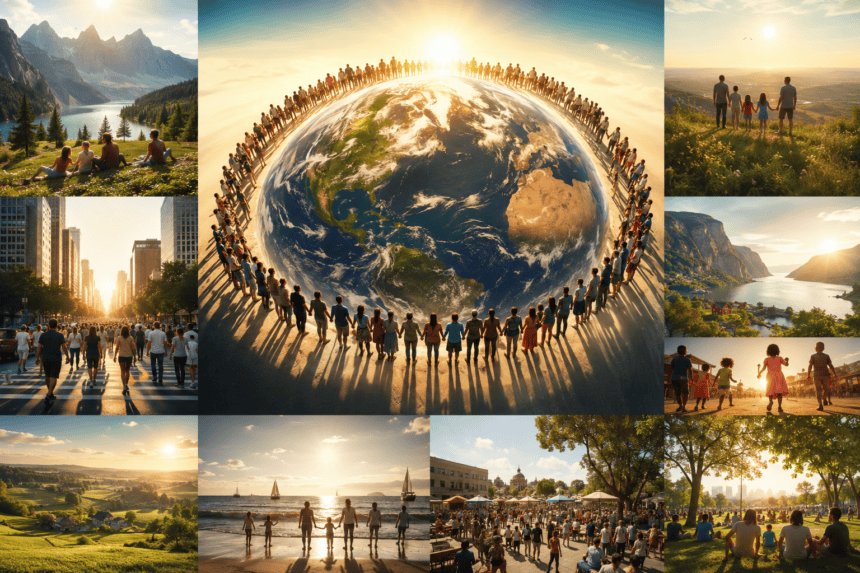
For a fleeting window between May 18 and July 17, the vast majority of Earth’s population will share the sun’s presence simultaneously. Data from geographers confirms that roughly 99% of people on the planet experience daylight at the exact same time during this period.
It’s a rare alignment of human geography and orbital mechanics.
Most of the world’s landmass sits in the Northern Hemisphere. During these months, the Earth is tilted toward the sun, bathing the Americas, Europe, Africa, and most of Asia in light. While the sun sets in the east and rises in the west, the overlap is absolute.
The peak of this phenomenon occurs at 11:15 UTC (Coordinated Universal Time). At this specific moment, the sun is positioned over the Pacific Ocean, illuminating the most populated regions of the globe.
Why does the remaining 1% stay in the dark? It comes down to the deep night of the Southern Hemisphere. While the north enjoys its long days, parts of Australia, New Zealand, and the southern tips of South America fall into the shadow. Even then, the “dark” isn’t total; many of these regions experience astronomical twilight, where the sun is just below the horizon but still provides a lingering glow.
For observers in the Northern Hemisphere, this period marks the longest days of the year, culminating in the summer solstice. For those in the south, it’s the heart of winter.
Despite the extreme seasonal contrast, the math remains consistent. As long as the Earth maintains its current tilt, this two-month window ensures that nearly every human being on the planet is touched by the sun at once. It’s a quiet, global synchronization that passes unnoticed by most, yet defines the rhythm of the entire world.