
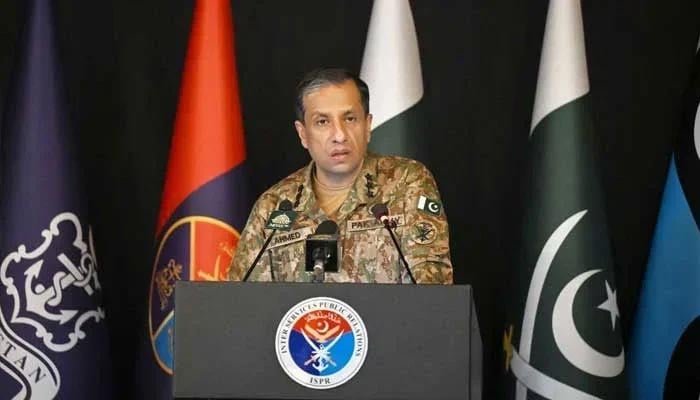
PESHAWAR: Pakistan’s top military spokesperson, Lt Gen Ahmed Sharif Chaudhry, warned that the country’s failure to enforce the National Action Plan (NAP) and weak governance, particularly in Khyber-Pakhtunkhwa (K-P), are driving a dangerous resurgence of terrorism.
Speaking at a press conference in Peshawar, the Director General Inter-Services Public Relations (DG ISPR) said terrorism in Pakistan is growing because political leaders have neglected the plan that was once unanimously approved by all parties after the Army Public School attack.
“Terrorism exists today because we are not following the National Action Plan,” Lt Gen Chaudhry said, urging authorities to act decisively before more lives are lost.
K-P at the Heart of the Terror War
K-P, long at the frontline of Pakistan’s anti-terror efforts, now faces renewed violence. According to the DG ISPR, around 70% of all terrorist attacks in the country occur in this province. Despite thousands of security operations, he said the provincial government’s failure to govern effectively has allowed a “terror-crime nexus” to thrive fueled by narcotics smuggling, illegal trade, and the use of non-custom-paid vehicles.
He also criticized past decisions to oppose sealing the Pak-Afghan border, claiming such moves protected criminal networks rather than national security.
Security Operations and Rising Casualties
The DG ISPR shared detailed operational data:
- In 2024, 14,535 intelligence-based operations (IBOs) were conducted in K-P, killing 769 terrorists, including 58 Afghan nationals.
- In 2025 (up to September 15), 10,115 IBOs killed 970 terrorists, while 311 army personnel were martyred.
- Nationwide, 57,320 IBOs took place this year, with 70.5% of incidents occurring in K-P.
Despite these efforts, Lt Gen Chaudhry lamented that zero convictions have been recorded in counterterrorism cases due to the judicial system’s inefficiency. Over 4,600 cases remain pending, he said, calling the situation “deeply alarming.”
“The vacuum created by bad governance is being filled with the blood of our martyrs,” he remarked.
Judicial Weakness and Political Interference
He strongly criticized the judiciary for failing to deliver justice in terrorism-related cases and accused political elements of appeasing militants and politicizing counterterrorism.
“Calling for talks with non-state actors is not peacebuilding it is a failure of governance,” he asserted.
Afghanistan’s Role and Cross-Border Threats
Lt Gen Chaudhry also highlighted the growing threat from terror groups operating from Afghanistan, calling it a “serious regional challenge.” He said Pakistan had shared evidence with Kabul that Afghan soil was being used by the TTP and other non-state actors to launch attacks inside Pakistan.
While avoiding direct comment on recent explosions in Kabul, he reiterated Pakistan’s stance:
“Afghanistan is a brotherly country, but it must not allow its soil to be used for terrorism against Pakistan.”
He revealed that most terrorists active in Pakistan are Afghan nationals, many armed with abandoned U.S. weapons worth $7.2 billion left behind in Afghanistan.
Call for Unity and Accountability
Lt Gen Chaudhry called for a national consensus to revive and fully enforce the National Action Plan, which he said has been sidelined by political divisions.
“All parties agreed on this plan. But where is its implementation?” he asked.
Ending on a resolute note, he stressed that Pakistan must rely on its own strength:
“We cannot beg others for security. Appeasement of terrorists and their facilitators is never a policy.”