Due to its astonishing and satirical predictions, the globally famous cartoon series The Simpsons is now being linked to claims that it also predicted the hantavirus outbreak on a cruise ship.
The Simpsons is an American animated cartoon series that began in 1989 and has gained worldwide fame because of its surprising and satirical predictions.
Following the recent emergence of hantavirus cases on a cruise ship, various rumors started circulating on social media, claiming that the famous American cartoon show The Simpsons had predicted the outbreak years ago.
Previously, the cartoon series has been credited with accurately depicting future events, scientific inventions, and political changes, including major predictions such as Donald Trump’s presidency, 9/11, and Elon Musk’s acquisition of Twitter (X).
According to reports, eight cases of hantavirus were reported on the cruise ship “MV Hondies,” while reports also indicated the deaths of three individuals. Experts confirmed that the infected individuals were carrying the Andes virus strain.
According to medical experts, hantavirus is a rare but dangerous disease transmitted to humans through rodent droppings, urine, or saliva. The virus can also spread through contaminated particles inhaled into the body.
Experts said hantavirus does not easily spread from one person to another. Its early symptoms resemble common flu, but in severe cases it can develop into “Hantavirus Pulmonary Syndrome,” which severely affects the lungs and can become life threatening.
Some social media users claimed that the tongue of an infected person turns purple due to the virus. However, experts stated that this does not occur directly because of the virus, but rather due to oxygen deficiency in the body during severe infection, causing the skin, lips, or tongue to appear bluish or purple.
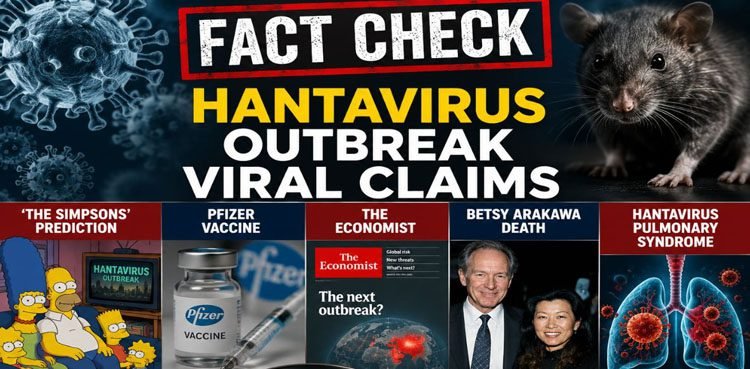
Experts clarified that there is no explicit prediction related to hantavirus in The Simpsons, while claims linking Pfizer’s COVID-19 vaccine to the disease are also baseless.
Similarly, some individuals linked the cover of The Economist magazine to conspiracy theories, but experts explained that such covers are merely editorial illustrations and not predictions of the future.
Experts advised the public to rely on authentic medical information instead of believing rumors. According to them, the current risk of the virus for the general public remains low, though cleanliness and rodent prevention measures are necessary.