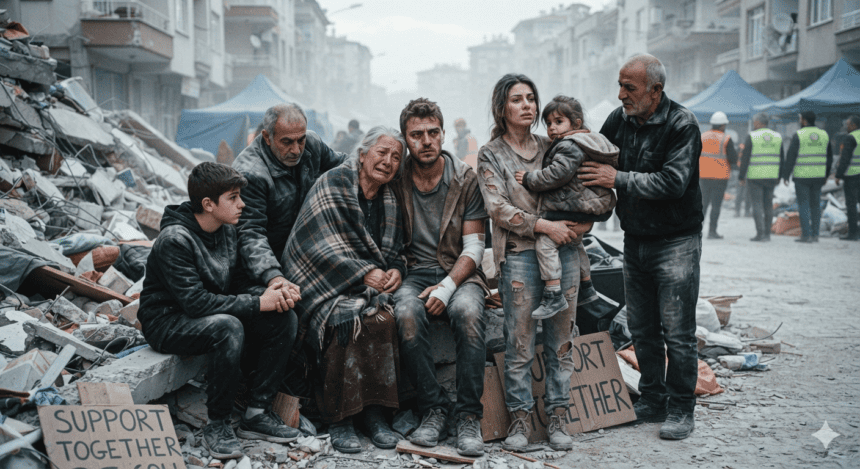
Headline: When Help Fails, Disaster Survivors Forge Their Own Recovery
When the cameras leave, the real work begins. In the wake of catastrophic floods and earthquakes, survivors aren’t waiting for government aid that often arrives too late or in insufficient quantities. Instead, they are formalizing informal networks, turning neighborhood survival groups into the primary engines of recovery.
These grassroots coalitions—often born out of necessity in the first 48 hours—are outpacing traditional aid agencies in efficiency. By mapping their own neighborhoods, survivors identify who has a generator, who has medical training, and whose home remains structurally sound. It is a shift from passive victimhood to active, localized governance.
“We didn’t wait for the trucks,” said Amira Khan, who coordinated a relief hub in a flood-hit district of southern Punjab last year. “We knew the local topography better than any contractor. We knew which elderly residents couldn’t walk to the main road. We just started doing it ourselves.”
The data supports this pivot. Independent studies of disaster zones show that survivors who embed themselves in local mutual-aid networks recover financially and psychologically faster than those relying solely on institutional relief. These groups bypass the bureaucratic hurdles of eligibility forms and proof-of-loss documentation, which often exclude the most vulnerable.
Yet, this self-reliance comes with a heavy toll. Volunteer leaders—often survivors themselves—frequently suffer from secondary trauma as they manage the immediate needs of their neighbors. They are not trained for disaster management, and they lack the legal protections afforded to official aid workers. When resources run dry, these groups often collapse, leaving the community vulnerable once more.
Governments are slowly taking notice. Some municipalities have begun integrating these local leaders into official emergency response planning, recognizing that institutional reach rarely extends to the last mile. However, the tension remains: the state prefers control and standardized protocols, while survivors prefer speed and local intimacy.
The next disaster is inevitable. As climate patterns intensify, the infrastructure of the future won’t just be reinforced bridges or sea walls. It will be the strength of these neighborhood networks—the people who refuse to wait for someone else to save them.