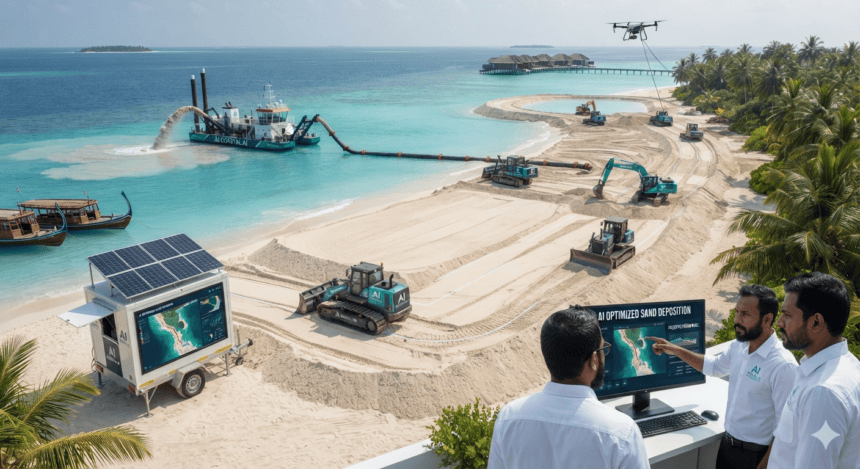
The Maldives is running out of sand. As rising sea levels swallow the archipelago’s low-lying islands, the government has turned to artificial intelligence to engineer a solution. Engineers are now using satellite imagery and machine learning to simulate how waves interact with the shore, identifying exactly where to place sandbags and breakwaters to stop the erosion.
The stakes are existential. Roughly 80% of the Maldives sits less than a meter above sea level. When monsoon storms hit, they don’t just cause minor flooding; they strip away entire stretches of beach, threatening the tourism industry that sustains the national economy.
Traditional coastal defense methods—usually massive concrete sea walls—often backfire. They disrupt the natural flow of currents, causing sand to pile up in one spot while starving the beach a few miles down the coast. AI changes that calculus. By running thousands of “what-if” scenarios, researchers can predict how a specific structure will alter water currents before a single shovel hits the sand.
“We aren’t just guessing anymore,” said one environmental consultant working with the Ministry of Environment. “The models show us the ripple effect of every intervention. We can protect a resort without destroying the neighbor’s beach.”
This digital approach relies on historical data from the last decade of storm surges and tidal shifts. The AI identifies patterns in sediment movement that human eyes simply miss. It then suggests precise angles for artificial reefs—structures designed to break wave energy far offshore, allowing sand to naturally settle back onto the beach rather than washing out into the deep ocean.
Yet, technology has its limits. While these AI-driven defenses can buy time, they cannot stop the global rise of the Indian Ocean. The Maldives is currently one of the most vocal nations at international climate summits, arguing that while they can engineer a temporary fix, the long-term survival of the islands depends entirely on global carbon emissions.
For now, the focus is on “soft” engineering. Instead of massive concrete barriers, the country is increasingly relying on these AI-optimized reef placements. It’s a race against the tide, using code to hold the shoreline in place while the rest of the world debates the pace of the climate transition.