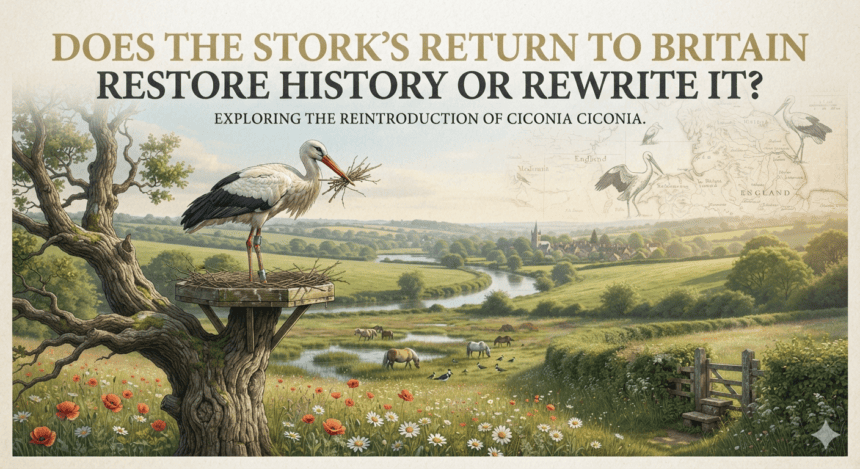
The white stork is back in the British countryside, nesting on rooftops from Sussex to Norfolk after a 600-year absence. What was once considered a medieval curiosity—or a mere nursery rhyme fixture—is now a point of contention among ecologists, land managers, and historians.
The birds didn’t return on their own. They were reintroduced through the White Stork Project, a multi-year effort to restore the species to its historic range. Proponents view the nesting pairs as a triumph of rewilding, a tangible correction to centuries of habitat loss and human persecution.
But is it a restoration or an invention?
Critics point to the lack of definitive evidence that white storks were ever a permanent, breeding fixture in Britain. While they appear in medieval records and heraldry, many historical accounts likely describe transient visitors—birds pushed off-course by storms or migrating through on their way to the Continent. By establishing a permanent population, the project may be filling a niche that wasn’t actually empty, potentially prioritizing a romanticized vision of the “past” over current biodiversity needs.
The project’s own data suggests a different priority: ecosystem health. Storks are apex predators in wetland environments, and their presence forces a re-evaluation of land use. In areas like the Knepp Estate in West Sussex, the return of the stork has become a catalyst for restoring floodplains and managing scrubland. The birds are doing the work that humans haven’t been able to replicate: breaking up dense vegetation and creating space for other species to thrive.
“We aren’t looking to recreate a specific year in the 1400s,” said a project lead during a recent update. “We are looking to restore the functional role of a large wading bird that Britain’s landscape has been missing.”
Still, the question of “rewriting” history persists. Rewilding initiatives often face accusations of “shifting baseline syndrome,” where modern conservationists set targets based on incomplete historical memories rather than hard biological data. If the stork wasn’t a native resident, is this an act of historical correction or an elaborate experiment in landscape engineering?
The answer matters because it dictates how we manage the land. If the stork is a native returnee, it justifies intensive protection and habitat modification. If it’s an introduced species, it’s a non-native animal, regardless of its cultural charm.
For now, the storks are focused on the immediate task of survival. They are building massive stick nests on chimneys and platforms, indifferent to the scholarly debate raging below them. Whether they belong in Britain’s past is a matter for historians; whether they belong in its future will be decided by whether they can survive the next century of climate change and shifting agricultural policy.
The birds have already rewritten the skyline. Whether they have restored history remains a secondary concern to the residents who now watch them hunt in the fields—the first time such a sight has been common in England since the Wars of the Roses.