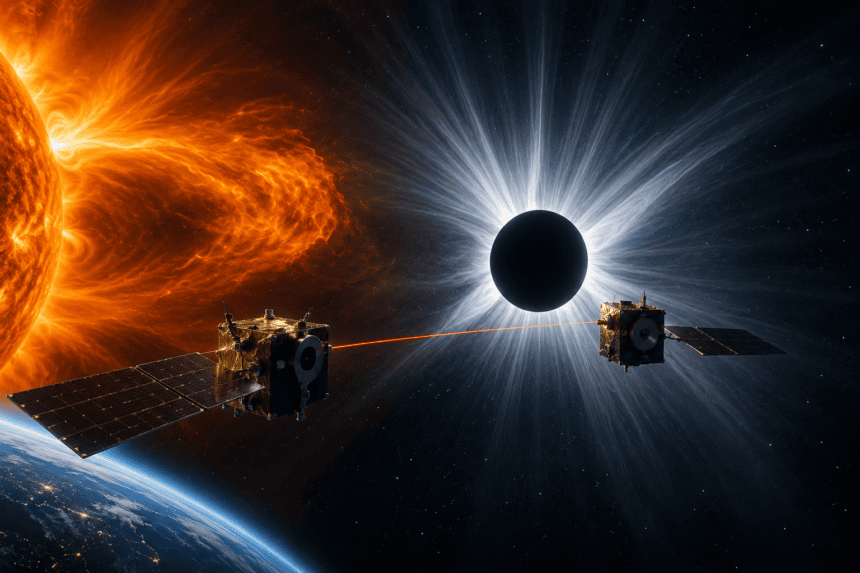
The European Space Agency (ESA) has officially launched the Proba-3 mission, a bold attempt to master the physics of the solar corona by creating artificial eclipses in orbit. By deploying two satellites flying in precise formation—one carrying a coronagraph and the other acting as an occulting disk—the mission aims to bridge a critical gap in our understanding of the Sun’s outer atmosphere.
For decades, solar scientists have struggled to capture the inner corona—the region closest to the Sun’s surface—because the Sun’s own brilliance washes out the faint light from the corona. While natural eclipses provide a brief window, they are short-lived and geographically limited. Proba-3 changes the math. By flying the two satellites 144 meters apart, the occulting disk will block the Sun’s disk, allowing the coronagraph to observe the corona for hours at a time, rather than seconds.
The stakes for this data are high. The corona is the birthplace of the solar wind, the stream of charged particles that can wreak havoc on Earth’s power grids, satellite communications, and GPS systems. Understanding how this wind is accelerated and heated remains one of the “holy grails” of heliophysics. If the formation-flying technology holds, it could turn the inner corona from a blurry mystery into a high-definition laboratory.
“We are essentially building a giant, orbiting eye that can stare into the fire without going blind,” says a lead mission scientist. The challenge lies in the precision. The two spacecraft must maintain their relative positions with millimeter-level accuracy, despite the gravitational tugs and solar radiation pressure of space. It’s a feat of formation flying that has never been attempted at this scale.
The mission, which launched into a highly elliptical orbit, will spend the next several months commissioning its instruments. Once the two satellites are locked into their dance, the scientific community expects a steady stream of imagery that could finally explain why the corona is millions of degrees hotter than the Sun’s surface—a paradox that has puzzled physicists for over a century.
While the data won’t stop a solar storm from hitting Earth, it will provide the baseline physics needed to predict them with far greater reliability. For the engineers and scientists behind Proba-3, the mission isn’t just about taking pictures of the Sun; it’s about proving that we can manipulate space-based infrastructure to see what was previously hidden in plain sight.