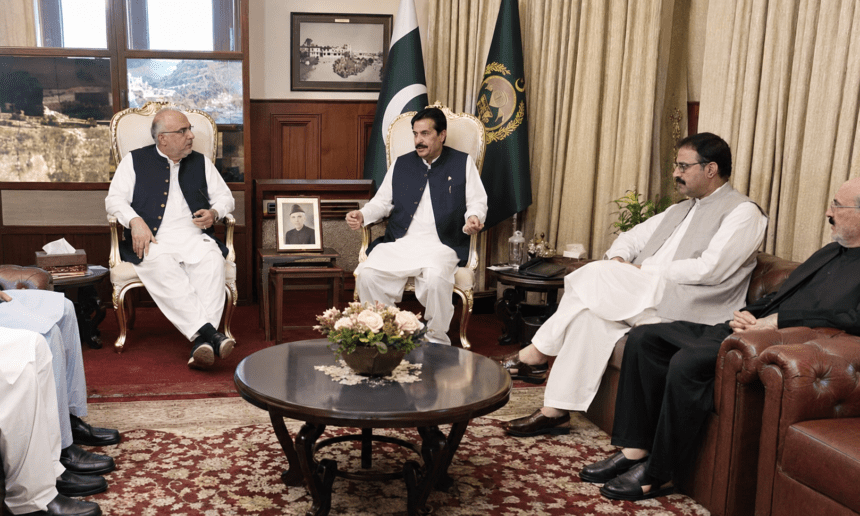
PESHAWAR, May 10 — Khyber Pakhtunkhwa Governor Faisal Karim Kundi on Sunday urged political leaders to present the province’s case to the federal government “firmly” and in a collective voice after meeting a Pakistan Tehreek-e-Insaf delegation at the Governor House in Peshawar. The meeting brought together PTI leaders including former National Assembly speaker Asad Qaiser and KP PTI president Junaid Akbar, along with other parliamentarians.
According to reports on the meeting, the discussion was not just symbolic. It centered on a cluster of issues that have been weighing on the province for months: CNG closures, wheat-related concerns, National Finance Commission matters, and the difficulties faced by the merged districts as well as the business community. In his public remarks, Kundi said KP’s constitutional and economic rights should be taken up with Islamabad in a coordinated way rather than through scattered political messaging.
That matters because relations between Peshawar and the Centre have rarely stayed calm for long. Even when rivals are sitting in the same room, there is usually a larger power struggle humming in the background. Sunday’s meeting looked, at least on the surface, like an attempt to carve out some common ground on provincial demands that cut across party lines.
The PTI delegation included Qaiser and Junaid Akbar, while other participants named in current coverage were MNAs Mehboob Shah and Saleem Rehman, as well as former MNA Saeedullah Shah. Reports said the exchange focused on what both sides described as pressing provincial issues, especially those tied to rights, resources and the economic burden on local communities.
Kundi’s formulation was politically notable. He did not frame the matter as a party contest alone, but as a provincial case that should be argued with force and with unity. In Pakistan’s federal politics, that kind of wording usually signals an effort to widen the conversation beyond routine opposition-versus-government point scoring. Whether that actually produces movement from Islamabad is another question, and honestly, that is where these meetings often run into familiar walls.
There is also recent history here. Kundi and PTI have not exactly operated in a warm political climate, and past interactions between the governor and PTI delegations have taken place against moments of constitutional tension and hard bargaining in KP politics. That makes the latest contact worth watching, even if no concrete package or agreement emerged immediately from Sunday’s talks.
For now, what is clear is this: both the symbolism and the substance of the meeting were aimed at one message — Khyber Pakhtunkhwa’s grievances, especially on finances, trade-linked restrictions and the needs of the merged districts, should not be treated as secondary. Kundi’s pitch was that the province will carry more weight if its demands are advanced collectively and without hesitation before the Centre.